Blockchain reinsurer Re deploys $134m in reinsurance capital for Jan renewals

This content is copyright to www.artemis.bm and should not appear anywhere else, or an infringement has occurred.

Blockchain-backed reinsurer Re has announced the deployment of $134 million in reinsurance capital across multiple programs as the industry begins to head into the key January renewals season.

re-blockchain-reinsuranceRe is a decentralised reinsurance infrastructure platform that leverages blockchain technology, seeking to bring greater transparency and efficiency to the global reinsurance capital market.

Established in 2022, the company bridges traditional and crypto capital markets with reinsurance, enabling investors to earn yield from insurance premiums while giving insurers streamlined access to capital.

Moreover, Re confirmed that as the January 1st renewals unfolds, the $134 million of reinsurance capital will be deployed across its insurance partners’ programs, as well as renewed authorisations.

The deployment of reinsurance capital for the renewals has been made across a broad range of insurance lines, including commercial auto, general liability, property, and workers’ compensation.

The firm emphasised that these authorisations represent real insurance programs supported by Re’s on-chain capital infrastructure rather than abstract financial products.

“This milestone reflects more than just a number. It’s evidence of growing confidence in Re’s model, the maturation of our marketplace, and our expanding role as a critical piece of infrastructure in the global insurance system,” Re commented.

The firm also outlined how its marketplace continues to gain meaningful, sustainable traction.

“We’re not just building infrastructure in isolation. We’re actively deploying capital that protects businesses and individuals across the economy,” Re explained.

“The fact that this $134 million includes both new programs and renewals is particularly meaningful. New programs show that additional insurers are choosing to work with Re. Renewals demonstrate that existing partners are seeing value and coming back. Both signals point to the same conclusion: the model is working.”

Additionally, Re highlighted three key ways in which blockchain technology is helping to strengthen the reinsurance market.

“Traditionally, this market has been dominated by large institutions operating through opaque, inefficient processes. Deals get structured through lengthy negotiations, capital allocation happens behind closed doors, and access to the market has been limited to the largest players. Re is changing that equation.

“By bringing transparency, efficiency, and accessibility to reinsurance through blockchain technology, we’re creating a more resilient global safety net for insurance risk. Capital providers can see exactly what they’re backing, insurers can access capacity more efficiently, and the entire process operates with transparency,” the company explained.

Re continued: “The insurance industry is facing mounting pressures: climate change is increasing the frequency and severity of natural disasters, economic uncertainty is creating volatility in claims patterns, and traditional reinsurance capacity has become more expensive and harder to access in certain lines. In this environment, innovation isn’t optional, it’s essential.

“The industry needs new sources of capital, new ways of structuring risk, and new infrastructure that can adapt quickly to changing conditions. Re provides all three.”

Concluding: “As the January 1st season unfolds, this authorized capital will be deployed across our insurance partners’ programs. Each dollar represents coverage capacity, the ability for insurers to confidently write policies, knowing they have reinsurance backing. We expect this momentum to continue. As more insurers experience the benefits of Re’s platform, and as more capital providers see the risk-adjusted returns available, the network effects strengthen.”

Blockchain reinsurer Re deploys $134m in reinsurance capital for Jan renewals was published by: www.Artemis.bm
Our catastrophe bond deal directory
Sign up for our free weekly email newsletter here.

Cat bonds highlighted as an untapped fixed income impact and return opportunity

This content is copyright to www.artemis.bm and should not appear anywhere else, or an infringement has occurred.

While fixed income is the world’s largest asset class, it is not commonly recognised for investments making social or environmental impact. But a recent report explains why investors should look more closely at fixed income assets and catastrophe bonds are highlighted as one impact investing opportunity within the segment.

sustainable-investment-cat-bonds-ils-esgThe report comes from a research collaboration between Builders Vision, an investor and philanthropist team that looks to accelerate impact solutions and counts the Walton family office as a backer, Tideline, a consultancy that works to catalyse the development of the impact investing market, and BlueMark, a verification and intelligence provider to the impact and sustainable investing market.

Catastrophe bonds and other insurance-linked securities (ILS) have long been cited for their ability to generate real impact in society, through their ability to transfer natural disaster and weather risk to the capital markets, while payouts from the instruments go towards insurance claims, paying for reconstruction and redevelopment after catastrophe strikes.

While the ILS community and many across insurance and reinsurance markets recognise the societal value of risk transfer and the protection it affords, increasingly we are seeing catastrophe bonds in particular highlighted as an opportunity for impact investors.

Catastrophe bonds and other ILS investments certainly meet the topic of a fixed income instrument that can deliver meaningful and positive societal impact, that is often hidden from sight of many allocators.

The authors of the report argue that “impact fixed income is a rapidly growing asset class with predictable and comparable financial returns to traditional fixed income investments.”

One of the key features of the fixed income asset class that is particularly relevant for the cat bond and ILS asset class is “responsiveness”, which the report authors explain as, “capacity to rapidly mobilize capital to address our most urgent needs, such as responding to natural disasters and pandemics.”

In highlighting the impact potential of catastrophe bonds, the report authors refer to the case of the Tohoku, Japan earthquake in 201.

Some readers will recall that the Tohoku earthquake resulted in the triggering and total loss to the $300 million Muteki Ltd. catastrophe bond transaction.

The Muteki Ltd. cat bond was issued in 2008 by global reinsurance company Munich Re on behalf of Japanese cooperative Zenkyoren, one of the longest-standing sponsors of catastrophe bonds.

The Muteki catastrophe bond utilised a parametric index trigger and so was able to payout relatively quickly to the benefit of Zenkyoren. The earthquake occurred on March 11th 2011 and we reported on the confirmation that the Muteki deal had been triggered and would face a total loss on May 7th that year.

The report, Scaling Solutions: The Fixed Income Opportunity Hiding in Plain Sight (available here) explains that the example of the Muteki cat bond shows fixed income instruments having impact in meeting urgent needs in real time.

It states, “Following the 2011 Tōhuku earthquake and tsunami—the fourth most powerful earthquake in recorded history — catastrophe bonds were instrumental to raising capital to support disaster relief. Issued by Munich Re, JA Kyosai’s catastrophe bond was able to raise USD $300 million for timely disaster payouts.”

Meeting urgent needs in real time is an “underappreciated” and unique impact function of fixed income, as evidenced by the cat bond structure, “which are distinct from those of other asset classes, yet critically important and complementary to an impact investing toolkit,” the report explains.

For fixed income in general, the report points to its suitability for such use-cases, given the inherent liquidity, the fact it is a well-established asset class, has a long history of investor confidence and established market infrastructure.

Of course, we are just cherry-picking one small example from the report as it references cat bonds, but overall we feel it is well-deserving of a read as it drives home many of the things we’ve written about for years, regarding the use of ILS as impactful disaster risk financing structures.

In the report’s conclusion the following paragraphs resonate with the remit of the cat bond and ILS market, “Fixed income has long been the bedrock of institutional allocators’ portfolios—valued for its financial capabilities of generating stable and predictable returns, adding liquidity, and providing essential diversification benefits. However, its potential as a powerful lever of social and environmental impact has been relatively untapped and underexplored. It is time to shift the narrative on fixed income. Fixed income is more than just an instrument for capital preservation. Rather, it has enormous and growing potential as a vehicle for achieving targeted and authentic impact outcomes at scale.

“With global challenges demanding trillions in capital, expanding the impact investing toolkit to include a broader range of instruments—particularly those capable of mobilizing large volumes of capital—is essential. To this end, investors must be intrepid in exploring how fixed income, the world’s largest asset class, can be intentionally activated for impact. And institutional asset allocators, as by far the largest investors in the fixed income markets, are uniquely positioned to lead the charge.”

Again, the full report, Scaling Solutions: The Fixed Income Opportunity Hiding in Plain Sight, is available to download here.

Cat bonds highlighted as an untapped fixed income impact and return opportunity was published by: www.Artemis.bm
Our catastrophe bond deal directory
Sign up for our free weekly email newsletter here.

Jamaica’s PM credits disaster risk financing with reducing debt burden after Hurricane Melissa

This content is copyright to www.artemis.bm and should not appear anywhere else, or an infringement has occurred.

Reflecting on the impacts of Hurricane Melissa, Jamaica’s Prime Minister Dr. Andrew Holness has stressed the importance and effectiveness of responsive disaster risk financing instruments in reducing the country’s debt burden in the aftermath of the hurricane.

According to estimates from the World Bank Group, in coordination with the Inter-American Development Bank (IDB), the physical damage to Jamaica caused by Hurricane Melissa totals US$8.8 billion, which is equivalent to 41% percent of the country’s 2024 GDP, making it the costliest hurricane recorded in Jamaica’s history.
The World Bank confirmed that the Global Rapid Damage Estimation (GRADE) which was conducted immediately after the hurricane, assessed physical damage across residential, non-residential, infrastructure, and agricultural sectors. However, the estimation does not include broader economic losses, which are expected to be even more significant.

Preliminary findings revealed that 41% of the assessed damages were to residential buildings, 33% to infrastructure, 21% to non-residential buildings, and 5% to the agriculture sector, which includes livestock and related infrastructure.

Speaking in Parliament yesterday, PM Holness said: “The authorities administrative expenditure will be financed from the national budget, as other agencies are, however, recovery and reconstruction activities will be financed initially from the National Natural Disaster Recovery Fund, the NNDRF.

“The NNDRF was set up to receive the proceeds of Jamaica’s disaster risk instruments, including Jamaica’s catastrophe bond, policies with the Caribbean catastrophe reinsurance facility CCRIF and various credit contingent claims with the IDB and the World Bank. These amounts will total US $650 million.”

Shortly after having its CCRIF parametric tropical cyclone insurance triggered by major hurricane Melissa’s winds, we reported that Jamaica was set to receive a payout under its CCRIF SPC parametric excess rainfall policy, taking the total it will receive to $91.9 million.

On that same day, the World Bank also confirmed that the Government of Jamaica will also receive a full 100% payout of its $150 million IBRD CAR Jamaica 2024 parametric catastrophe bond.

This announcement was not particularly unexpected, as just days after Melissa made landfall in Jamaica, the World Bank had suggested that a payout of the country’s catastrophe bond was likely.

PM Holness continued: “It is likely that the government of Jamaica will have to borrow to finance reconstruction beyond what will be available in our NNDRF. We have immediate access to approximately and please note, I use the word approximately, US $500 million from the IMF Rapid Financing facility the RFI. The RFI facility does not come with policy conditionality, so we will start this reconstruction effort with approximately US $1.15 billion in immediate funds.

“This is significant. To mention this under normal circumstances, it would take us three fiscal years to spend such funds in capital expenditure under normal circumstances.

“Just infrastructure there is $2.9 billion of infrastructure damage, that you could say is the government’s responsibility totally. And then there is a part of residential that would be government as well. And then there is a part of private, meaning private homes and private facilities that government may also have to assist. And then there is the relief and the recovery expenditure.”

Adding: “So we have here a total of US $1.15 billion, a part of it is the insurance and the contingencies that we have, and a part of it is immediately accessible debt that we could start but just from the assessment here, which is not the final assessment.

“You know, there’s $8.8 billion of damage for which the government would more likely be responsible for at least half. So, there is still a gap that will have to be funded, and that will have to be funded by additional borrowing.”

It’s important to remember that if it were not for the $650 million that Jamaica will receive from the cat bonds, parametric insurance from the CCRIF and other contingent disaster risk financing instruments, the government would have needed to borrow that sum as well. This would have increased the country’s debt burden and worsened its debt to GDP ratio.

“The government has to be frugal. It has to be careful. It has to watch no more than ever. It has to watch every dollar that is spent,” PM Holness said.

Concluding: “Because, yes, we are in a good position. No doubt, we have never been in a position when a disaster struck. And we don’t have to be scrounging around to find $1.15 billion, we have it there to start.

“That is because of the fiscal management of the government that builds resilience in our fiscal affairs.”

Previously, debt had always been the default answer for countries recovering from natural disasters. But increasingly layered approaches to disaster risk financing, across all forms including insurance products, is becoming a valuable way to decrease the debt burden post-event, by planning before the worst happens.

There is, of course, nothing wrong with debt arrangements, as long as the overall financing structure for an economy is considered, with costs and the responsiveness of different instruments well thought through.

Also read for more news on hurricane Melissa and Jamaica’s catastrophe bond:

– Hurricane Melissa crosses Jamaica cat bond parametric boxes at 892mb, 100% payout likely.

– Hurricane Melissa losses in Jamaica likely to fall to reinsurers, says AM Best. BMS suggests $5bn+.

– Melissa insured impacts in the billions. Jamaica cat bond full loss most likely: Twelve Securis.

– Jamaica’s cat bond “doing what it was designed to do” – Lefferdink, Aon Securities.

– Hurricane Melissa estimated single-digit billion insured loss. Cat bond payout likely: Aon.

– Jamaica cat bond marked near zero after Melissa landfall. Calculation process underway.

– World Bank says Jamaica catastrophe bond payout “likely” for hurricane Melissa

– No adverse ILS market reaction expected from Melissa cat bond payout: Fitch

Jamaica to receive full $150m payout from parametric cat bond after Hurricane Melissa: World Bank

Premier Ebanks urges Cayman Islands to consider cat bonds after Hurricane Melissa

Jamaica’s PM credits disaster risk financing with reducing debt burden after Hurricane Melissa was published by: www.Artemis.bm
Our catastrophe bond deal directory
Sign up for our free weekly email newsletter here.

Collateralized reinsurance and innovation – Expanding access to protection and capital: McKeown, Vantage Risk

This content is copyright to www.artemis.bm and should not appear anywhere else, or an infringement has occurred.

With collateralized reinsurance emerging as a key tool for insurers seeking greater flexibility and access to alternative forms of capital, the industry’s focus should be on expanding the overall market for protection, drawing on all types of capital to meet rising demand, Chris McKeown of Vantage Risk told us in an interview.

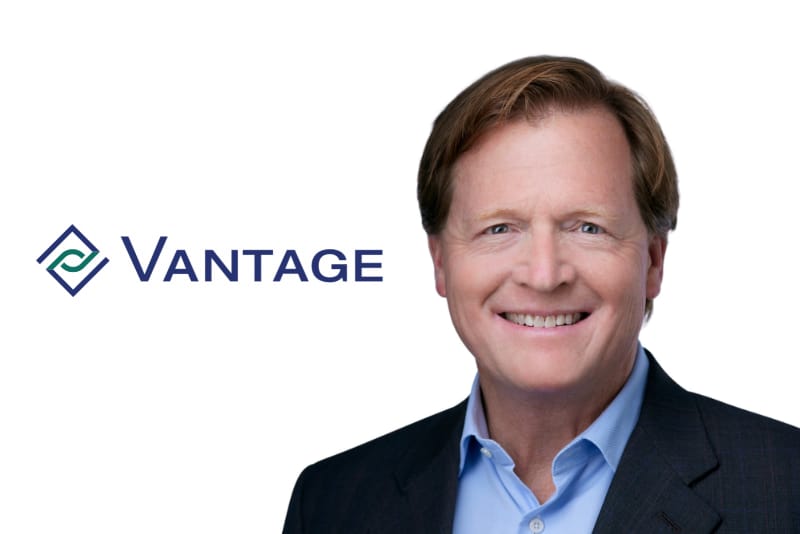
chris-mckeown-vantageMcKeown, who serves as Chief Executive, Reinsurance, ILS, and Innovation at the firm, discussed with Artemis where he sees the balance between collateralized reinsurance and other alternative capital structures shifting towards in the next few years.
“I think there’s tremendous opportunity when we talk about the “protection gap”, the fact that, globally, we still don’t sell enough protection against catastrophic events or risk in general. It’s human nature to put on blinders a bit when it comes to what could happen, and unfortunately, that tendency carries over into our industry,” McKeown said.

“We all have an opportunity to grow the market for protection. The question is whether there’s enough balance sheet capital to keep pace in order to continue providing products that meet that growing need. Maybe there isn’t, but that’s where innovation can play a role.”

The executive told Artemis that he believes more of that innovation will stem from insurance-linked securities (ILS) structures, investors and vehicles that are willing to take on new kinds of risk and push into new products or business models.

“Parametric products are a key example,” McKeown said. “They haven’t quite taken off yet, but they illustrate what’s possible: a simpler, more user-friendly way to buy protection.

“Instead of filing a claim and waiting for an adjuster, a customer could receive a payout automatically if a defined event like a certain amount of rainfall or wind speed occurs. That kind of innovation, supported by ILS capital, could really help expand the overall market.”

McKeown also states that a large batch of investors are sophisticated in their own use of artificial intelligence (AI) and modeling, affirming that they’re asking the right questions that are tackling product innovation that addresses risks more efficiently.

In fact, McKeown stressed that those conversations with ILS investors are highly important and serve as a real catalyst for change and growth across the industry.

“That said, I think we’ll see more affiliated, or hybrid models emerge. Models that bring in collateral to support portfolios, either by fronting for collateralized reinsurers or by partnering with them directly. In some cases, that might even displace the rated carrier altogether, allowing capital to flow more directly to MGAs or other distribution partners. We’re already seeing examples of E&S carriers and MGAs receiving direct support from ILS-backed security or similar structures,” the executive added.

“Overall, I think this is a growing and evolving market, one that’s serving as a catalyst for us to think differently about how to grow the overall pie. Whether that growth comes at the expense of traditional reinsurance or cat bonds isn’t really the point. The goal should be expanding the total market for protection, and to do that, we’ll need to continue accessing all types of capital as we move forward.”

Moving forward, McKeown shared Vantage Risk’s views on AI, and whether the technology is a major priority for the firm going forward.

“It’s a broad topic, but we’ve fully embraced and worked to understand the applications of AI. From day one, we’ve been very deliberate in how we build and structure our data so that it can be cleanly interrogated over time and in the future.

“We’re fully cloud-based, and of our 360 people, about 80 to 85 are focused on data, analytics, and technology – data engineers, data scientists, and data technicians. Their role is to ensure our data remains accessible and usable, whether by humans or machines, as the business evolves,” McKeown said.

“That’s been a major focus for us. Because one of the biggest challenges with legacy systems is that the data they contain, even if it exists, often can’t be accessed or used meaningfully. You might have the machines, but if the data isn’t clean, you’re not going to get the right answers. So, we’ve invested heavily in getting that foundation right,” the executive added.

McKeown explained to Artemis that Vantage is continuously exploring applications of large language models in order to understand how they can enhance the firm’s own operations and how they’ll be incorporated into the broader market.

“We’ve already embedded several AI initiatives internally, particularly around data management and technology enablement, but we haven’t launched anything outward-facing as a commercial carrier just yet,” McKeown said.

“That said, we believe this is fundamentally a relationship-driven business. It requires people to talk to people. Having better, richer information is a huge advantage, but AI isn’t going to replace the core functions of underwriting or the human dialogue with brokers and clients that underpins those decisions. So, our focus with AI, and with all of our technology initiatives, is really about empowerment, arming our curious, experienced, and intellectually driven underwriters with better tools and insights to make smarter decisions, and to explain those decisions clearly to their counterparties.”

To conclude, we asked McKeown to outline what he feels are the biggest challenges and opportunities within the ILS space today.

“One interesting trend we’re seeing is a shift in investor behaviour. Initially, many investors entered the catastrophe space opportunistically, they saw a year where rates were high, modeled returns looked attractive, and liquidity was available through instruments like catastrophe bonds.

“Naturally, they pursued those opportunities. But now we’re hearing a different question from our investors: ‘How can we ensure continued access to this business over time?’

“That’s where the affiliated model (the one we operate under) becomes important. We have a balance sheet business, a core insurance operation that our 360 staff are deeply committed to. When we see market opportunities, we can bring in partnership capital to participate. But if those opportunities dry up because of market competition or shifts in buying behaviour, we’re not dependent solely on fees. Our model combines underwriting income with fee income, and that’s what makes Vantage unique,” McKeown concludes.

Read all of our interviews with ILS market and reinsurance sector professionals here.

Collateralized reinsurance and innovation – Expanding access to protection and capital: McKeown, Vantage Risk was published by: www.Artemis.bm
Our catastrophe bond deal directory
Sign up for our free weekly email newsletter here.

Cat bond market helps CEA reduce its reinsurance attachment point and costs

This content is copyright to www.artemis.bm and should not appear anywhere else, or an infringement has occurred.

Over the last year the California Earthquake Authority (CEA) has benefited from strong execution in the catastrophe bond market to lower both its reinsurance attachment point and costs associated with risk transfer.

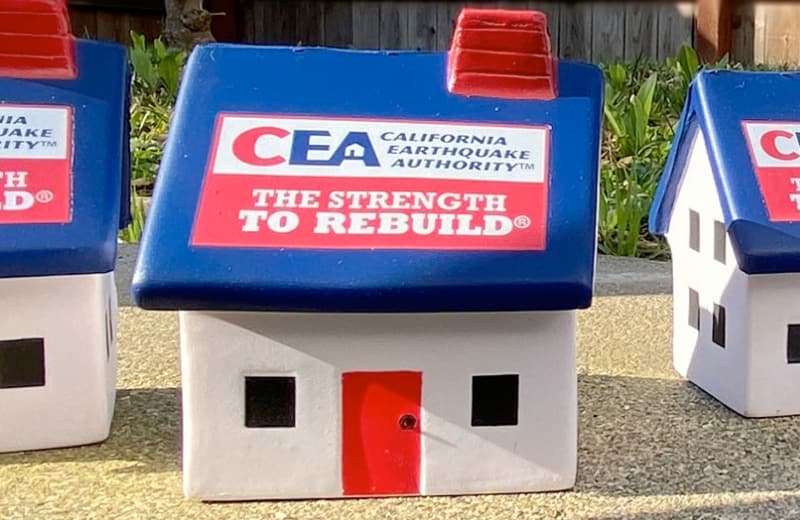
california-earthquake-authority-imgWith now three catastrophe bonds sponsored so far in 2025, the California Earthquake Authority (CEA) has steadily increased the capital markets share of its overall reinsurance tower arrangements.

While price execution in the cat bond market, thanks to what are now dramatically reduced spreads over its cat bonds issued through the last year, have assisted. Notably, it is also cat bonds that have helped the earthquake insurer shave $400 million of the attachment point for its reinsurance protection.

When we last reported on the CEA’s reinsurance tower, the traditional and collateralized or fronted reinsurance limit component had declined to $5.22 billion as of July 31st 2025.

Now, the latest data available shows a further decline in this traditional reinsurance component, with it falling to just over $5.06 billion as of September 30th 2025.

At the same time, the catastrophe bond market component had reached $2.61 billion as of the same date, with this having increased thanks to a June cat bond issuance, the $400 million Ursa Re II Ltd. (Series 2025-1).

As we reported this week, the CEA has now secured a further $770 million in cat bond coverage from its latest Ursa Re II Ltd. (Series 2025-2) deal, which settles in the next week.

For the CEA, the capital markets and catastrophe bond investors have delivered significant value in risk transfer terms over the last year.

Roughly a year ago, the CEA had just over $5.72 billion of traditional reinsurance in-force and $2.27 billion of cat bond protection outstanding.

Since then, the traditional reinsurance component has shrunk, through to September 30th 2025, while the cat bond component has grown.

While risk transfer purchases overall have shrunk there is now discussion over whether some of the industry and member assessments that would furnish parts of the upper-layers of the CEA’s funding tower could be replaced, either with reinsurance or more catastrophe bonds.

Given how efficient cat bonds could be at those top-layers of the CEA’s tower, above where it has bought private market coverage previously, it will be interesting to watch how its arrangements evolve going forwards.

The overall risk transfer tower does stand slightly smaller still though, as the CEA manages its protection to meet its needs for limit, but given the three cat bonds sponsored in 2025 it suggests the insurer is finding conditions in the capital markets to have been more conducive for securing protection through 2025 so far.

Notably, the catastrophe bond market has helped the CEA lower its overall attachment point for reinsurance in the last year.

The June issuance, the $400 million Ursa Re II 2025-1 cat bond, has an attachment point at $1.7 billion of losses to the CEA.

In its latest board documents, the CEA noted that its reinsurance attachment level reduced from $2.1 billion to $1.7 billion in its last quarter of record, which has protected an additional $400 million of capital for the earthquake insurer.

At the same time, in 2025 the CEA reported a $70 million reduction in its risk transfer expenses as well, which is in part due to reduced limits being purchased, but also due to softer reinsurance market conditions.

The reduction in attachment points, as the CEA opted to buy coverage from the capital markets in cat bond form lower-down, did offset this somewhat, but it’s clear the insurer is finding great value in expanding its cat bond coverage right now.

This is particularly evident in the new catastrophe bond that priced this week, the $770 million Ursa Re II Ltd. (Series 2025-2) deal.

As we were first to report in our coverage on that pricing earlier this week, both tranches of notes offered have priced with spread multiples-at-market that are the lowest in the CEA’s history of sponsoring cat bonds.

Notably, there is an October 2023 issued tranche of one of the CEA’s cat bonds with a comparable initial expected loss to one of the tranches of this 2025-2 deal that priced this week and the spread multiple of the newly issued tranche is some 46% lower.

Spread multiples for the CEA’s cat bond issuances have been coming in over the last year and a half for the insurer, which has no doubt helped to drive some of the risk transfer savings. This latest cat bond, which is additional to the September 30th figures reported, will only continue that trend.

Looking ahead, for the CEA’s reinsurance tower, as we said the insurer has $505 million of its $2.61 billion of cat bonds scheduled to mature at the end of this month.

Which means, once this new $770 million issuance is settled and that maturity has occurred, the CEA will go into 2026 with $2.875 billion of catastrophe bond backed reinsurance limit available to it.

At the same time, on the traditional and collateralized or fronted reinsurance side, of the CEA’s just over $5.06 billion of cover at September 30th 2025, some $646.5 million was up for renewal as of October 1st this year, but we do not know at this stage how much protection the CEA bought from reinsurance market’s at that date.

For the CEA, the January 2026 reinsurance renewal will be a particularly big one for the insurer, as it has approaching $2.54 billion of its traditional reinsurance limit that expires on December 31st.

Meaning the CEA’s overall risk transfer, reinsurance and catastrophe bond tower could change significantly over the coming months and there is also a chance the earthquake insurer looks to the capital markets again.

Given the very strong price execution and the fact catastrophe bond investors have helped the CEA reduce its attachment points as well as delivering on the greatly reduced risk interest spreads required, there is every chance the CEA returns if it feels it can achieve a better outcome and multi-year collateralized cover by sponsoring additional cat bonds over the next couple of months.

The CEA has $2.61 billion of outstanding catastrophe bond coverage still in-force as of today, sitting 5th in our cat bond sponsors leaderboard.

When the new $770 million Ursa Re II deal settles on November 25th it will increase the CEA’s cat bond backed coverage to one of the highest levels it has ever stood at, of $3.38 billion, which will propel the CEA to the top of our cat bond leaderboard for a short time.

But then $505 million of cat bonds will mature at the end of this month bringing it back down to $2.875 billion of cat bonds in-force as of December 1st 2025, leaving the CEA back in fifth place again.

View details of every catastrophe bond sponsored by the CEA in the Artemis Deal Directory.

Cat bond market helps CEA reduce its reinsurance attachment point and costs was published by: www.Artemis.bm
Our catastrophe bond deal directory
Sign up for our free weekly email newsletter here.

Abundant capacity & competition puts further pressure on reinsurance prices: Fitch

This content is copyright to www.artemis.bm and should not appear anywhere else, or an infringement has occurred.

Abundant capacity and increasing competition among reinsurers are leading to softer pricing during the June and July renewals, which supports Fitch Ratings’ expectation that market pressures will persist in affecting prices even after the peak in 2024.

fitch-ratings-signAs per Fitch, pricing across most reinsurance lines continued to gradually fall at the mid-year reinsurance renewals, just like it had at both the January and April renewals, while rates for loss-free property programmes fell by 10%-15%.

Considering this, Fitch has suggested that declining prices, increased claims severity from natural catastrophe events, and slightly looser terms and conditions in property lines are likely to lead to lower underwriting margins in 2025.

Of course, underwriting margins have been under pressure from sustained price erosion and increased claim severity, most notably from the Los Angeles wildfires and other natural catastrophe losses seen throughout the first half of 2025.

The agency states that the global reinsurance market has ample capacity as rising supply outpaces incremental demand from cedants, which according to the agency, is shifting pricing power to be in favour of reinsurance buyers, particularly in property lines, while the balance remains more even in casualty.

“Competition is generally focused on price rather than T&Cs. Property reinsurance revenue growth is underpinned by increased risk awareness among cedants and higher insured values, leading to increased coverage. Reinsurer appetite to write US casualty cover is mixed, with some reinsurers increasing their appetite and others withdrawing,” Fitch commented.

Furthermore, Fitch states that T&Cs are beginning to loosen as reinsurers become more willing to provide protection lower down on programmes, including at lower attachment points and for more frequent return periods.

“Working-layer and aggregate reinsurance protection are making a comeback, and reinsurers are becoming more open to negotiating T&Cs,” Fitch added.

“The first signs of less stringent T&Cs are emerging, driven by heightened competition and a very gradual relaxation of underwriting discipline.”

Despite this, Fitch noted that pricing remains above historical levels, and sector fundamentals still support strong, albeit off-peak, profitability.

Furthermore, Fitch confirmed that it will review its global reinsurance sector outlook ahead of the reinsurance industry’s annual Rendez-Vous de Septembre gathering in Monte Carlo. The sector outlook is currently ‘neutral’.

Read all of our reinsurance renewal news coverage.

Abundant capacity & competition puts further pressure on reinsurance prices: Fitch was published by: www.Artemis.bm
Our catastrophe bond deal directory
Sign up for our free weekly email newsletter here.

IDF designs parametric flood insurance product for Lagos State Government

This content is copyright to www.artemis.bm and should not appear anywhere else, or an infringement has occurred.

The Insurance Development Forum (IDF) has completed the design of a parametric flood insurance solution for the Lagos State Government in Nigeria as part of the Tripartite Agreement Programme.

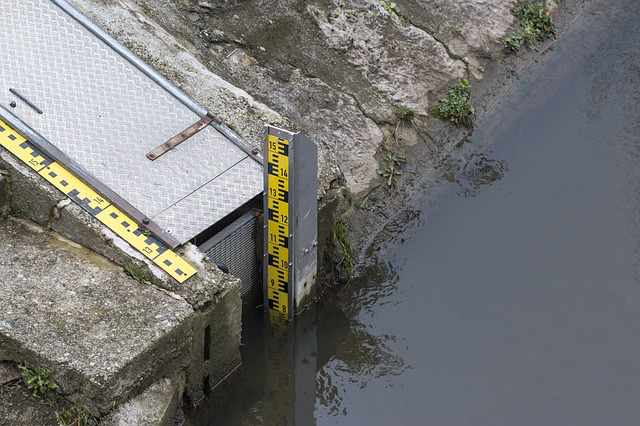
water-level-parametric-floodThe solution was developed as part of the Tripartite Agreement Programme of the IDF, the United Nations Development Programme (UNDP), and the German Federal Ministry for Economic Cooperation and Development (BMZ) through the InsuResilience Solutions Fund (ISF).

The design of this sub-sovereign risk transfer solution was undertaken by a team of IDF member organisations in partnership with the Lagos State Government, including AXA Climate, Swiss Re, AXA Mansard in Nigeria, flood modeler JBA Risk Management, satellite company ICEYE, and African Risk Capacity Ltd. (ARC Ltd.), supported by the UNDP team in Nigeria.

Partners in Nigeria reportedly include the Lagos State Government, the Lagos State Ministry of Finance, Lagos State Ministry of Budget and Economic Planning, and the Lagos State Emergency Management Agency (LASEMA).

As the IDF explains, flooding in Lagos State disproportionately affects poor and vulnerable populations, while climate change is reportedly increasing the frequency and severity of such events.

“The innovative parametric insurance product is projected to protect up to 4 million people by enabling swift financial support when pre-agreed flood triggers are met, based on satellite flood footprint data. In the event of a catastrophic flood, the product could provide access to up to USD 7.5 million in coverage,” the IDF commented.

Use of the product will allow the Lagos State Government to access funds to support emergency response efforts, including disaster relief and direct cash transfers to affected communities.

“The product forms a key part of Lagos State’s wider flood risk management and climate resilience strategy. UNDP is supporting the Government of Nigeria to scale the flood insurance project to a national scheme,  developing a National Disaster Risk Finance Strategy and contributing to the integration of risk finance into Nigeria’s Nationally Determined Contribution (NDC) 3.0,” the IDF explained.

The IDF has also confirmed that regulatory approval for the product has been obtained, with the next steps set to include the state government arranging premium financing options, which will facilitate the integration of the product into Lagos State’s catastrophe contingency and fiscal planning frameworks.

Dr Oreoluwa Finnih, Special Adviser to the Governor of Lagos State on Sustainable Development Goals, commented: “The delivery of this parametric flood insurance solution is a vital milestone in strengthening Nigeria’s adaptation to manage climate risk. It exemplifies the innovative public-private partnerships needed to build fiscal resilience and help communities prepare for climate impacts. We look forward to seeing this product implemented and protection in place for Lagos State.”

Ivo Menzinger, Chair of the IDF Operating Committee, Managing Director and Executive Advisor at Swiss Re, said: “This milestone demonstrates the power of collaboration between  government, insurance, and development partners. The design phase harnessed the industry’s technical  expertise in flood risk modelling and parametric insurance to develop a tailored, scalable  solution for Lagos. We are committed to supporting local ownership as this solution moves  towards regulatory approval and integration into government systems.”

Dr. Annette Detken, Head of the InsuResilience Solutions Fund (ISF), added: “This achievement marks a pivotal step in our mission to build climate resilience through innovative risk financing. By supporting the development of this parametric flood insurance solution for Lagos State, the ISF is helping to unlock timely and reliable financial protection for those vulnerable to climate-related disasters. This is precisely the kind of locally owned, scalable solution the Tripartite Programme was designed to deliver, one that strengthens systems, builds capacity, and lays the foundation for long-term resilience in Nigeria.”

IDF designs parametric flood insurance product for Lagos State Government was published by: www.Artemis.bm
Our catastrophe bond deal directory
Sign up for our free weekly email newsletter here.

Gallagher Re structures and places innovative multi-peril parametric policy for SEADRIF and Lao PDR

This content is copyright to www.artemis.bm and should not appear anywhere else, or an infringement has occurred.

Gallagher Re, the global reinsurance broker, on behalf of the Southeast Asia Disaster Risk Insurance Facility (SEADRIF Insurance Company), has structured and placed a parametric re/insurance programme for the government of Lao PDR.

gallagher-re-logoAccording to the broker, the two-year policy expands the original 2021 flood-only placement, to include additional perils such as typhoons, earthquakes, and landslides.

The policy was established on May 3, 2025 and provides up to $16 million in aggregate parametric protection.

Moreover, the policy’s payout triggering mechanism is based on actual, reported loss information aggregated at the national level, which makes it one of the first, globally, to use a government-reported impact-based trigger.

Gallagher Re also explained that the parametric structure is triggered by the number of people that are affected by a covered peril, which established domestic agency, the National Disaster Management Office (NDMO), independently reports.

The reports are typically available within days after an event, and their use as a parametric trigger for financial response is backed by advanced analytical work carried out by Gallagher Re.

“This new type of trigger was required because traditional hazard-based markers are unable to fully capture the variety and complexity of flood and other catastrophe events in the region,” commented Gallagher Re.

The resulting NDMO-based framework helps to address both SEADRIF and the government of Lao PDR’s needs for financial protection products which closely align with the observed impacts on livelihoods.

“The product shows great potential to be further scaled up and to help reduce the protection gap in the region in the future,” Gallagher Re added.

“Gallagher Re is proud to have collaborated with SEADRIF on renewing this groundbreaking product. This achievement was underpinned by comprehensive analytical work and close consultations with clients and markets,” commented Antoine Bavandi, Global Head of Public Sector, Parametric & Climate Resilience Solutions at Gallagher Re.

Adding: “Our innovative parametric set-up further pushes the boundaries of disaster risk finance and represents a solution that is both simple and more reliable. It captures the complexities of extreme catastrophe events such as flooding whilst minimizing basis risk. It shows great potential for replicability in flood-prone countries and we look forward to further expanding it with SEADRIF in the region.”

“We appreciate the technical leadership of Gallagher Re in bringing this enhanced policy to reality. This milestone represents not only a significant achievement for SEADRIF but also an advancement in parametric insurance products,” said Benedikt Signer, Executive Director of SEADRIF Insurance Company.

“We are committed to serving all ASEAN member countries and making a meaningful impact to protect vulnerable populations and fostering sustainable development. We look forward to our continued partnership with Gallagher Re to expand our impact,” Signer concludes.

Gallagher Re structures and places innovative multi-peril parametric policy for SEADRIF and Lao PDR was published by: www.Artemis.bm
Our catastrophe bond deal directory
Sign up for our free weekly email newsletter here.

GC Securities worked on record number of cat bonds in H1 2025: Guy Carpenter CEO Klisura

This content is copyright to www.artemis.bm and should not appear anywhere else, or an infringement has occurred.

GC Securities, the investment banking and capital markets unit of reinsurance broker Guy Carpenter, worked on a record number of catastrophe bonds in the first-half of 2025, according to the broker’s CEO Dean Klisura.

dean-klisura-guy-carpenterSpeaking today during a second-quarter earnings call for parent company Marsh McLennan, Guy Carpenter CEO Klisura explained that the reinsurance broker’s strong growth was helped by the high levels of activity seen in the catastrophe bond market, as well as across insurance-linked securities (ILS) and third-party capital raising.

Earlier in the earnings call, John Doyle, President and Chief Executive Officer of Marsh McLennan, mentioned the catastrophe bond market’s accelerated level of activity in 2025.

Doyle commented on Q2 activity for the broker, “A moderate increase in client demand was offset by reinsurers increasing capacity, as well as increased cedent cat bond issuance.

“The cat bond market is on pace for a record year of issuance, with over 50 new bonds in the first-half, involving approximately $17 billion of limit.”

Later in the call, Guy Carpenter’s CEO Klisura went into more detail.

He explained, “New business is very strong, it’s strong, and it’s balanced across our platform.

“As John noted, significant ILS activity, with record cat bond growth in the quarter. Guy Carpenter participated in 14 cat bond issuances in the quarter and 23 year-to-date, which is a record for Guy Carpenter.”

Here, we assume, Klisura is referring to the GC Securities unit’s activities in the catastrophe bond market, where it is one of the leading structuring, arranging and bookrunning specialists for cat bond issuances.

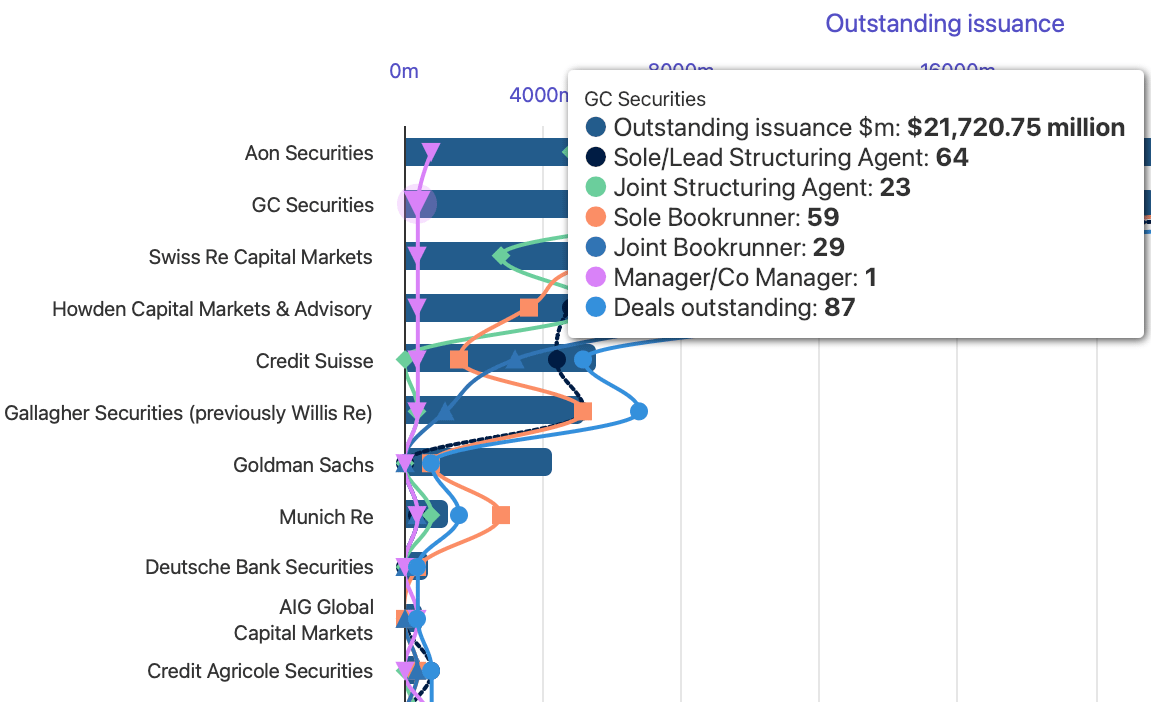
catastrophe-bond-bank-broker-leaderboardLooking at the Artemis leaderboard of catastrophe bond banks and brokers, GC Securities currently sits in second place, with an impressive over $21.72 billion of cat bond risk capital currently outstanding that the unit has worked on.

That risk capital outstanding comes from currently 87 outstanding cat bond deals we’ve tracked that GC Securities has provided its services to.

Looking back roughly one year, around the mid-point of 2024 GC Securities was associated with just over $16.22 billion of outstanding cat bonds from our Deal Directory from 72 deals.

So, over the last year the figure has jumped by $5.5 billion in risk capital outstanding and 15 more cat bond transactions, as GC Securities has expanded its business alongside the recent cat bond market growth spurt.

Klisura also referenced some of the Guy Carpenter Capital Advisory services, including where it assists re/insurers in raising third-party capital, often for reinsurance purposes just as much as for more traditional capital raising needs.

Klisura said, “We continue to see new opportunities in our capital and advisory practice. In the quarter, we won several mandates to raise third-party capital for clients large and small in the US and London, a number of well known MGAs in particular. And we’re winning M&A mandates, providing M&A advice and supporting activities for a number of those clients.”

Finally, Klisura also highlighted that despite demand for property catastrophe reinsurance easing up at the mid-year renewals, Guy Carpenter placed more limit for its clients.

“Property cat demand did ease up at the mid-year renewal. We sold an additional $5 billion of property cat limit through the mid-year renewals, helping to drive the drive the top line and we feel really good about our talent,” Klisura said. “As John noted, we’re attracting top talent in the market, and we’ve got a great, balanced organisation. We feel good about our prospects.”

GC Securities worked on record number of cat bonds in H1 2025: Guy Carpenter CEO Klisura was published by: www.Artemis.bm
Our catastrophe bond deal directory
Sign up for our free weekly email newsletter here.

Travelers renews mid-year catastrophe reinsurance and raises Long Point cat bond retention

This content is copyright to www.artemis.bm and should not appear anywhere else, or an infringement has occurred.

US primary insurer Travelers has renewed substantially the same of its largest catastrophe reinsurance arrangements at the mid-year renewal season, although with some changes and a broadening of another of its covers, and perhaps a non-renewal of smaller treaties, while for the second year running the company has lifted its catastrophe bond attachment higher up the tower again.

travelers-insurance-imageEarlier this year, Travelers increased the amount of protection it receives under its main occurrence catastrophe excess-of-loss (XoL) reinsurance treaty to $3.675 billion at the January 1st renewals, with a higher attachment.

Last July, after the mid-year 2024 reinsurance renewals, the insurer had purchased more northeast catastrophe reinsurance protection.

At the same time Travelers lifted the attachment point for its $575 million Long Point Re IV Ltd. (Series 2022-1) issuance from May 2022 by just over $300 million.

Now, at the mid-year of 2025, Travelers has renewed the same catastrophe reinsurance arrangements as last year, with the few changes detailed below, but further lifted the cat bond’s attachment point at its 2025 annual reset.

Travelers has renewed its Northeast Property Catastrophe Excess-of-Loss Reinsurance to provide the same $1 billion of coverage, from the same $2.75 billion retention to run through the end of June 2026.

The company notes that, “Recoveries under the catastrophe bonds (if any) would be first applied to reduce losses subject to this treaty.”

Also renewed for the next year is Travelers Personal Insurance Catastrophe Excess-of-Loss Reinsurance Treaty that covers specific named storm and hurricane exposures across United States coastal states from Texas to Maine, but excluding Florida, but now also covers all other perils as well..

For the 2024 hurricane season this reinsurance treaty only covered that peril and was renewed to provide $500 million of cover across a $1 billion layer for a single event, subject to a higher $2 billion retention.

For 2025, this treaty has been renewed at to provide much broader coverage, as far as we can see, while the retention has halved to $1 billion.

Alan Schnitzer, Travelers CEO said during an earnings call today, “You may recall that last year’s treaty had an attachment point of $2 billion. While in a modelled year we wouldn’t expect this to have much of an impact, given the prospect of continued weather volatility, we were pleased to obtain broader coverage at a reasonable cost.”

One other notable change to this renewal is that Travelers has not reported that its Middle Market Earthquake Catastrophe Excess-of-Loss Reinsurance Treaty has been renewed. This treaty was renewed a year ago and covered a one-year term to June 2025. So it appears the company may have non-renewed it this year, perhaps due to its other treaties having all grown to provide more reinsurance protection in recent years.

The companies Canadian Property Catastrophe Excess-of-Loss Reinsurance Treaty, has been adjusted to provide more coverage, now attaching at C$100 million but covering all losses up to C$400 million, where as a year ago it only covered a 50% share of losses between C$100 million and C$200 million, but then 100% of losses up to C$500 million.

So some adjustments there for this smaller treaty, which now covers more losses from the retention up.

Onto the Long Point Re catastrophe bond, which a year ago saw its attachment point lifted to provide its $575 million of cover after a $2.79 billion retention, up from a $2.48 billion retention the year prior.

Now, after the mid-year 2025 annual reset, Travelers Long Point Re cat bond will attach from a $2.89 billion retention.

Travelers has continued to adjust its catastrophe reinsurance, growing its larger and more expansive treaties, while making smaller ones more focused, while the cat bond remains a core component of its arrangements.

Read about Travelers second-quarter 2025 results over at our sister publication Reinsurance News.

Travelers renews mid-year catastrophe reinsurance and raises Long Point cat bond retention was published by: www.Artemis.bm
Our catastrophe bond deal directory
Sign up for our free weekly email newsletter here.