Property cat reinsurance rates remain attractive, market not yet soft: Jefferies

This content is copyright to www.artemis.bm and should not appear anywhere else, or an infringement has occurred.

Despite the fact property catastrophe reinsurance rates have moderated somewhat, analysts at Jefferies said the market remains attractive and they do not classify it as soft given pricing remains above 2022 levels at this time.

jefferies-logoCommenting on the property catastrophe reinsurance market after the mid-year 2025 renewals, the Jefferies equity analyst team highlight the influx of capital that helped to moderate pricing and make renewal outcomes more favourable for buyers.

“Increased capital deployed outpaced rising demand (estimated at ~10% increase in limit purchased) as increased capacity from newly formed reinsurers/syndicates/ILS funds more than offset incremental purchasing by cedants,” the analysts explained.

They highlight the very strong catastrophe bond issuance seen to-date, which as we explained recently has led to a new annual record being set by Artemis’ data.

Larger transactions and new sponsor entrants have helped to drive the catastrophe bond market to its record highs, but the Jefferies analyst team also think pricing remains attractive here despite some softening being seen.

“Despite larger transactions and new entrants in the market, CAT bond spreads, or pricing, have come in slightly since 1Q25 but are stable with 4Q24,” they explained.

While rates-on-line have fallen across many catastrophe reinsurance renewals this year, the analysts continue to see value in the sector for underwriters.

“Despite moderating rates, we believe property CAT returns remain attractive and do not view the market as soft given pricing is above 2022 levels,” the Jefferies team wrote.

Adding that, “Further, returns in Florida remain favorable despite pricing pressures relatively recent given tort reform.”

Jefferies analysis aligns with our recent article on a Peel Hunt report, which concluded that the inflection point into a full soft reinsurance market remains two to three years away.

Read all of our reinsurance renewal news coverage.

Property cat reinsurance rates remain attractive, market not yet soft: Jefferies was published by: www.Artemis.bm
Our catastrophe bond deal directory
Sign up for our free weekly email newsletter here.

Unipol reportedly secured €300m aggregate reinsurance cover

This content is copyright to www.artemis.bm and should not appear anywhere else, or an infringement has occurred.

News continues to emerge that reflects the increased availability of aggregate reinsurance protection, as an analyst report shows Italian insurance and financial services group Unipol secured a planned €300 million aggregate reinsurance treaty to better protect it against smaller catastrophes and weather losses.

unipol-logoAggregate catastrophe protection, to provide reinsurance for smaller catastrophe and weather losses on an accumulating loss basis, has been a more challenging product to source for a few years.

As the reinsurance market hardened after 2022, appetite to deploy limit to cover aggregate losses diminished, while the cost of aggregate reinsurance and retrocession covers also rose.

But, in 2025, these covers have become more available and affordable as well, with the catastrophe bond market one leading source of annual aggregate protection once again.

While at the same time, European protection buyers have also found reinsurers and ILS capital more accommodating for buying aggregate reinsurance from.

We reported back in May that during an earnings call General Manager of Insurance at Unipol, Enrico San Pietro, said that the company was aiming to buy a new aggregate reinsurance arrangement this year.

Now, in an analyst report from Berenberg, details of that purchase have been revealed.

The Berenberg analysts, after holding a speed-dating event with numerous re/insurers present, explained that Unipol executives said that the aggregate cat reinsurance cover will provide €300 million of limit.

The agreement was signed in May and attaches once aggregate losses surpass a €350 million retention, it is reported.

It’s also said that the aggregate cover only protect Unipol for weather and catastrophe events that cost it less than €100 million, while its main catastrophe reinsurance treaty will continue to provide the protection for larger events than that.

The Berenberg analysts report that Unipol’s new aggregate reinsurance treaty covers weather and smaller cat losses to both its motor and non-motor books of business.

While this is further evidence of the appetite to deploy capacity to aggregate covers recovering, other companies at the Berenberg event highlighted that capital remains disciplined, with high deductibles enforced and only relatively low limits available.

Aggregate reinsurance and retrocession has always been considered more of an earnings than capital cover, protecting the ability of re/insurers to hit their profit targets even when frequency loss events are prevalent throughout the financial year.

As a result aggregate protection remains a very attractive buy and we’ve seen plenty of aggregate cat bonds issued this year, especially in industry-loss trigger retrocessional form for large reinsurance companies.

We’ve also reported on aggregate reinsurance purchases that have come to light from global insurer Zurich and Bermuda-based reinsurance firm Conduit Re.

In the outstanding catastrophe bond market, just under 40% of limits currently at-risk are deployed to provide aggregate reinsurance protection.

But in the last few months, the prevalence of aggregate deals has increased a little, further signalling recovering appetites to deploy capacity and capital to these opportunities, which is being supported by attachments and prices remaining relatively stable and attractive still.

Of course, the greater availability of aggregate reinsurance has been a trend we’ve followed for some months, with notably more reinsurance capital available to support well-structured aggregate deals towards the end of 2024, which led reinsurance buyers to become more hopeful as we moved towards 2025.

Unipol reportedly secured €300m aggregate reinsurance cover was published by: www.Artemis.bm
Our catastrophe bond deal directory
Sign up for our free weekly email newsletter here.

Capital growth and pricing discipline drive stability at mid-year reinsurance renewals: Guy Carpenter

This content is copyright to www.artemis.bm and should not appear anywhere else, or an infringement has occurred.

The global reinsurance sector has entered the second half of 2025 with strong momentum, driven by a potent mix of capital inflows, favourable underwriting conditions, and robust investor returns, according to reinsurance broker Guy Carpenter.

guy-carpenter-logoDespite ongoing global economic volatility and insured losses nearing $70 billion through the first half of the year, the renewal trends seen at January 1 have largely continued, according to Marsh McLennan’s global risk and reinsurance specialist.

Although the first quarter of 2025 saw elevated loss activity, driven largely by the $40 billion in insured losses from the Los Angeles wildfires, insured loss activity moderated in the second quarter. As a result, aggregate losses are now flat compared to the inflation-adjusted five-year average.

Despite these events, reinsurers absorbed the impact without meaningful capital impairment. The sector ended 2024 with a record $607 billion in capital, and growth of 5% to 7% is forecast by year-end 2025.

In addition, reinsurer returns on equity were reportedly 16% in 2024 and are projected to be 15% in 2025, while reinsurance capital closed 2024 at an all-time high of $607 billion.

Guy Carpenter anticipates seeing a continuation of this trend, with capital growth of 5% to 7% by year-end 2025.

Dean Klisura, President and CEO, Guy Carpenter, commented: “The current trading environment is one of the most favorable for reinsurers in many years, evidenced by the additional capital being attracted to the sector.

“We see this as a tremendous opportunity to re-balance the market dynamics in our clients’ favor. More capacity will continue to moderate pricing, give clients more diversification of reinsurance partners, and provide better solutions to protect earnings.”

“Reinsurers easily absorbed the 5% to 7% increase in client demand for property catastrophe limit. Moreover, reinsurer capacity exceeded demand by more than 20%, driving risk-adjusted rate decreases of 5% to 15% for non-loss impacted programs, and risk-adjusted rate increases of 10% to 20% for loss-impacted programs,” Guy Carpenter explained.

Against this backdrop, the insurance-linked securities (ILS) market, particularly catastrophe bonds, has shown remarkable resilience and scale.

Issuance so far in 2025, across 144A cat bonds and private cat bonds sat at over $17.56 billion for the first half of 2025, which is very close to the Artemis-tracked annual record of $17.7 billion from full-year 2024, as new quarterly issuance records were set in both Q1 and Q2 this year.

Download your copy of the new Q2 2025 Artemis cat bond market report here to read more.

In 2025, GC Securities, Guy Carpenter’s capital markets arm, has led the way with 23 catastrophe bond placements, more than any other broker in the market year-to-date. This level of activity underscores continued investor demand for structured reinsurance risk, particularly as underlying insurance market conditions remain stable and loss activity has normalised.

Shifting focus to casualty, Guy Carpenter reported continued discipline at the Spring 2025 renewals, with two factors helping drive more stable outcomes.

“First, reinsurers and clients evaluated trading relationships across property, casualty, and specialty programs. Reinsurers looked to find balanced support across all programs for a given client.

“Second, carrier underwriting actions have improved casualty economics for reinsurers, particularly proportional programs where insurers share ground-up premium and loss.

“As a result, through mid-year renewals, ceding commissions on proportional placements generally renewed flat to slightly down following 18-24 months of reductions. Excess of loss placements continued to face rate pressure as loss severity drives more volatility for reinsurers – generally rates increased 10-20%, although each renewal was highly customized based on the individual portfolio,” the broker concluded.

Read all of our reinsurance renewal news coverage.

Capital growth and pricing discipline drive stability at mid-year reinsurance renewals: Guy Carpenter was published by: www.Artemis.bm
Our catastrophe bond deal directory
Sign up for our free weekly email newsletter here.

ILS drives structural flexibility and softer pricing at July renewals: Gallagher Re

This content is copyright to www.artemis.bm and should not appear anywhere else, or an infringement has occurred.

A wave of alternative capital, led by a record-setting surge in catastrophe bond issuance, helped reinsurers meet growing demand without pushing prices higher at the July 1 renewals, according to Gallagher Re, as cedants secured improved terms in property and specialty lines.

gallagher-re-logoWhile traditional reinsurance capital reached a new high of $769 billion at year-end 2024, Gallagher Re’s latest 1st View report highlights the critical role of insurance-linked securities (ILS) and cat bonds in sustaining competitive pressure through mid-2025.

Issuance so far in 2025, across 144A cat bonds and private cat bonds we’ve tracked, sat at over $17.56 billion for the first half of 2025, which is very close to the Artemis-tracked annual record of $17.7 billion from full-year 2024, as new quarterly issuance records were set in both Q1 and Q2 this year.

According to Gallagher Re, this wave of transactions, driven by strong investor demand and sponsor confidence, ultimately helped reinsurers meet increased demand without pushing prices higher.

Commenting on the July 2025 reinsurance renewals, Tom Wakefield, CEO Gallagher Re, said: “Buyers generally experienced a more competitive reinsurance market at the July 1 renewal compared to recent years, with capacity available even where demand increased, and reinsurers looking to grow.

“Clients were largely able to secure risk-adjusted rate reductions for property treaties and were well-placed to hold pricing broadly flat in casualty lines – in part, as underlying pricing increases continue to flow through to reinsurers.

“With these conditions in place, clients had the opportunity to challenge the status quo, and secure improvements to the structure and terms of their property and specialty reinsurance programs.”

Reinsurers entered the July renewals in “good financial shape” Wakefield noted, with strong 2024 results and ROEs well above the cost of capital.

“Q1 results were weaker due to the impact of January’s unprecedented wildfires in Los Angeles, California, but barring further exceptional cat events, reinsurers remain on track for another good year overall,” Wakefield added.

“As noted in Gallagher Re’s Reinsurance Market Report in April, reinsurers are currently on track to deliver healthy ROEs in the mid-teens for 2025, with traditional reinsurance capital set to increase by another 6% (assuming average results for the rest of the year).”

Despite these fundamentals, cedants achieved risk-adjusted rate reductions of 10–15% on average in property catastrophe programs, particularly for loss-free or structurally enhanced portfolios.

“The increase in reinsurance dedicated capital has been driven mainly by retained earnings at the traditional reinsurance groups, rather than new entrants or capital raises.” Wakefield added.

“We are also collaborating with clients to utilize non-traditional capital vehicles, such as sidecars, where interest in accessing insurance risk remains robust.”

While traditional capital hit new highs, it was the alternative capital layer that gave buyers greater flexibility, helping maintain competitive tension and push back against previously hardened terms.

The cat bond market remained highly efficient, with a Q2 weighted average upsize at 27% indicating investor oversubscription, and a steady market multiple of 3.09, even amid increased issuance.

“The influx of deals in Q2 has been met with ample investor capital, with sponsors continuing to experience deal-upsizes and spread reductions,” Gallagher Re explained.

Gallagher Re also highlighted a 10% increase in property cat sidecar market size since the start of the year and noted that casualty sidecars are gaining traction, with several new entrants accessing the structure in H1.

This marks a growing willingness among ILS investors to engage with more complex and diversified risks outside the traditional property catastrophe space.

Looking ahead, Gallagher Re explained that 2025’s renewals are showing a consistent trend: a market in which the balance of supply and demand has tilted back toward reinsurance buyers.

Reinsurers are increasingly looking to deploy their significant capital, but they remain disciplined in their approach.

Wakefield, added: “Buyers generally experienced a more competitive reinsurance market at the July 1 renewal compared to recent years, with capacity available, even where demand increased, and reinsurers looking to grow.

“With these conditions in place, clients had the opportunity to challenge the status quo, and secure improvements to the structure and terms of their property and specialty reinsurance programs.”

Read all of our reinsurance renewal news coverage.

ILS drives structural flexibility and softer pricing at July renewals: Gallagher Re was published by: www.Artemis.bm
Our catastrophe bond deal directory
Sign up for our free weekly email newsletter here.

After alternative structure review, Suncorp buys less reinsurance with minimal changes

This content is copyright to www.artemis.bm and should not appear anywhere else, or an infringement has occurred.

Australian primary insurance giant Suncorp Group has purchased a smaller reinsurance tower at the mid-year 2025 renewals and despite having spent time assessing alternative reinsurance structures, at this stage there appears to have been minimal change to its protection buying strategy.

suncorp-reinsurance-tower-2025-2026A year ago, Suncorp renewed its main catastrophe reinsurance tower to provide protection up to $6.75 billion, having lifted the top by $350 million at the mid-year 2024 renewal.

For the 2025 to 2026 year, Suncorp has reduced the size of its reinsurance tower and also non-renewed a drop-down arrangements, as it seemingly seeks to reduce its costs of protection, even while acknowledging improved reinsurance market conditions, from a buyer perspective.

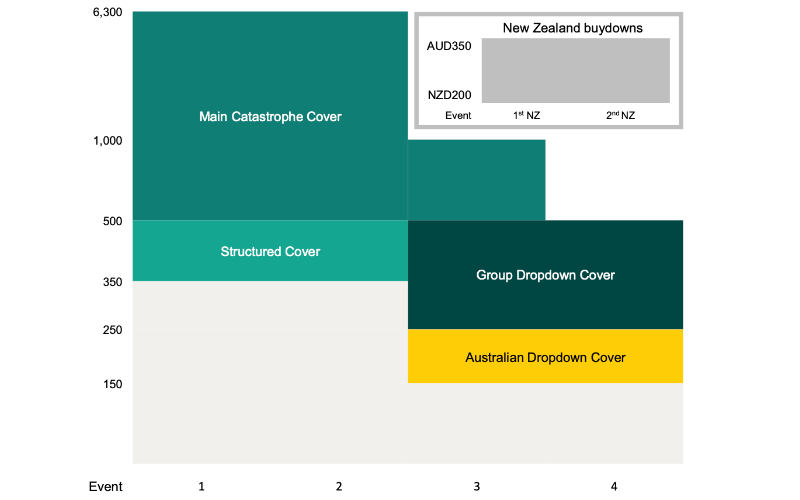
The renewed reinsurance tower features catastrophe limit up to a smaller $6.3 billion for the coming year, with catastrophe reinsurance available for major events from the same $350 million retention, for first and second events.

There are subtle changes to the overall reinsurance structure, that should enhance its responsiveness for the buyer, but in the main adjustments seem minimal.

Recall that, earlier this year, Suncorp said it was assessing “alternative” reinsurance structures for its next renewal at the mid-year, as the company looks to optimise its protection arrangements.

While there may be alternative capital embedded in the renewed program, on a collateralized or fronted basis, the insurer has not taken the step of venturing into the catastrophe bond market, or launching any kind of insurance-linked securities (ILS) structure of its own.

Suncorp said today that the review “explored a range of markets and both traditional and alternative reinsurance structures, including whole of account quota shares and aggregate cover programs,” with a goal to optimise for shareholder value.

“The review concluded that our clear objectives of optimising outcomes for our shareholders and customers would be best met by the program announced today,” Suncorp CEO Steve Johnston.

“In the current market, capacity has increased significantly for main catastrophe covers and pricing has improved. For other types of cover, including aggregate covers, capacity remains limited and expensive.”

Johnston added that Suncorp will “continue to monitor both traditional and alternative reinsurance markets and assess
future opportunities in reference to the considerations outlined above.”

Johnston also commented on reinsurance costs, saying, “Over the past couple of years, reinsurers materially reset their appetite for deploying capital to cover smaller or mid-sized events in both Australia and New Zealand. This, and increased reinsurance pricing, has seen the cost of insurance, particularly home insurance, increase rapidly.

“While the pricing of household policies will continue to reflect underlying risks and broader economic inflation, it’s pleasing that this major input cost appears to have stabilised.”

The main Suncorp catastrophe cover will protect the company against losses from $500 million and $6.3 billion, with one full prepaid reinstatement.

A multi-year structured reinsurance solution has been brought in to replace the group cover that reduced the retention to the aforementioned $350 million. This new addition features a profit share mechanism and reinsurer losses are capped at $600 million over a three-year term.

Suncorp noted that this new multi-year solution comes with lower cost, as well as the potential profit share benefits.

In addition, a second reinstatement of the $500 million to $1 billion layer of the main catastrophe program has been added, while citing it as inefficient, Suncorp said a dropdown limiting losses from a second event to $250 million has not been renewed.

Group dropdown covers have been purchased to reduce the third and fourth event retention to $250 million as well, and an Australian dropdown program continues to reduce retention for a third and fourth event in Australia to $150 million, while in New Zealand, buydown cover (including a prepaid reinstatement) has been purchased to cover between NZ$200 million and the Group’s maximum event retention of $350 million, in line with last year.

Analysts are calling the Suncorp program minimally changed this morning, saying that the company appears to be trying to further reduce its protection costs, despite its growing exposure base.

The upshot of the slightly changed reinsurance program is an expectation of slightly lower costs again for Suncorp, “reflecting strong reinsurance rate reductions and changes to the program, partially offset by exposure growth in the portfolio,” the company explained.

After alternative structure review, Suncorp buys less reinsurance with minimal changes was published by: www.Artemis.bm
Our catastrophe bond deal directory
Sign up for our free weekly email newsletter here.

Reinsurance capital outstrips demand at mid-year renewals: Aon

This content is copyright to www.artemis.bm and should not appear anywhere else, or an infringement has occurred.

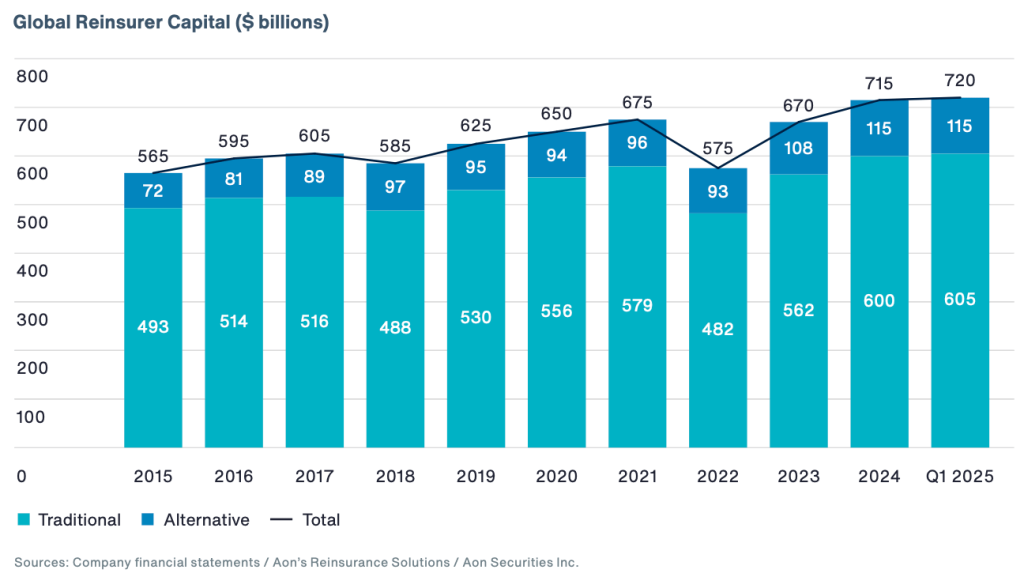
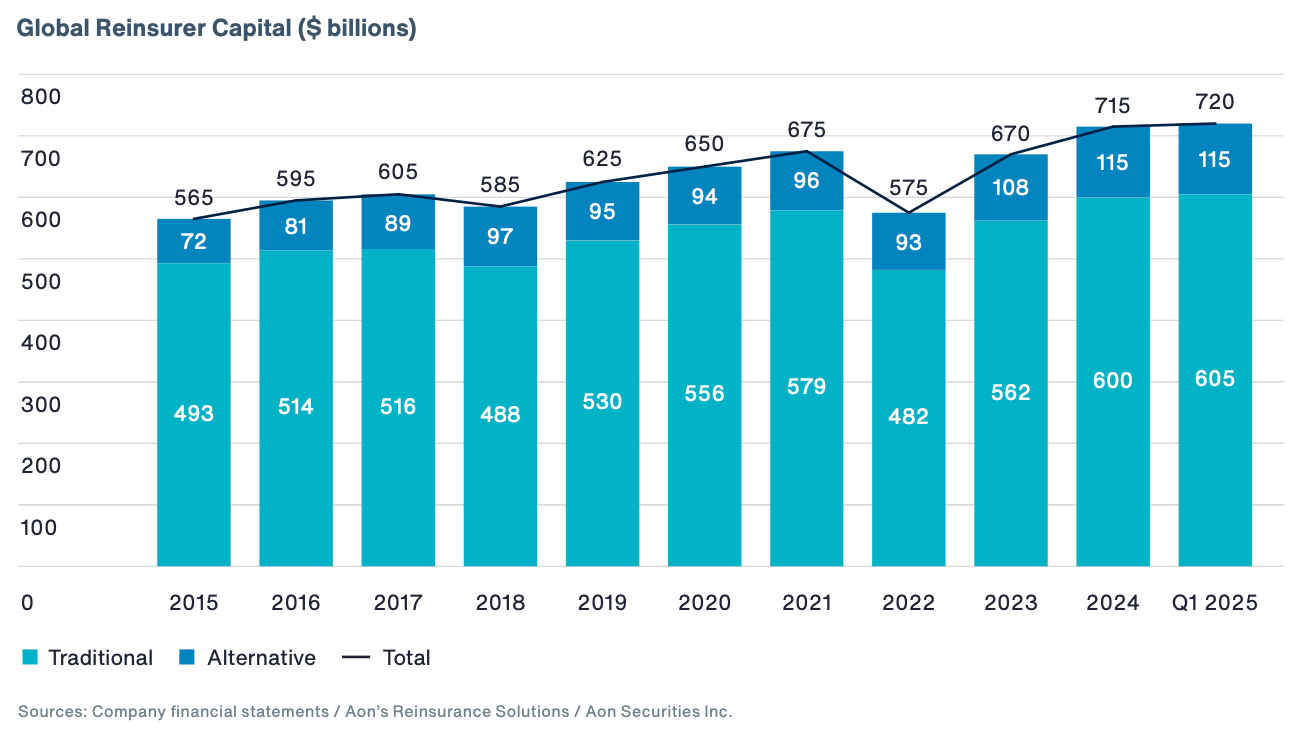
Global reinsurance capital outpaced demand at the 2025 mid-year renewals, fostering a more competitive environment for buyers, according to Aon. The firm also estimated that insurance-linked securities (ILS) capital remained stable at $115 billion as of the end of the first quarter, underscoring the ongoing strength and resilience of alternative capital sources.

“Coming at the start of the Atlantic hurricane season, June 1 and July 1 are key renewals for the U.S. and Latin America, as well as Australia and New Zealand. Despite an active first half for natural catastrophe losses, mid-year renewals experienced a broadly competitive environment as reinsurers, ILS markets and new entrants sought to deploy capacity and grow market share,” Aon explained in its mid-year 2025 renewals Reinsurance Market Dynamics report.

Global reinsurer capital rose by $5 billion to $720 billion in the first quarter of 2025, surpassing the previous record of $715 billion set in 2024, despite the financial impact of the California wildfires.

According to Aon, this growth was driven by strong retained earnings among established players, with two-thirds reporting double-digit annualised returns on equity.

At the same time, the catastrophe bond market posted record issuance in the first half of 2025 with the two largest transactions in the history of the market, each exceeding $1.5 billion.

In early May, Florida’s Citizens Property Insurance Corporation secured a then-record $1.525 billion of reinsurance from its Everglades Re II Ltd. (Series 2025-1) issuance.

Later on that month, State Farm then secured a record amount of reinsurance limit from the capital markets in a single visit in cat bond form, as it priced $1.55 billion of multi-peril protection via sponsorship of four Merna Re (Series 2025) cat bonds.

Moreover, Aon went on to note that reinsurance capacity was more than sufficient to absorb a near 10% increase in global demand for property catastrophe limit.

“The growth was largely driven by insurers in the U.S., influenced by significant depopulation of Florida’s windstorm insurer of last resort, Citizens. Other factors included inflation, model changes and revised views of natural catastrophe exposure, with recent wildfires in the U.S. and floods in Brazil prompting insurers to evaluate loss potential and protection needs,” the broker explained.

Furthermore, Aon estimates that equity reported by global reinsurers rose by $5 billion to $605 billion in the first quarter of 2025, continuing the recovery seen since 2022.

“The primary drivers have been strong earnings, following the market ‘reset’ in 2023, and the reversal of unrealized losses on fixed-income securities, due largely to the “pull-to-par” effect. Growth has been partly offset by increased capital returns to investors, as reinsurers look to reward loyalty,” Aon noted.

The broker added: “Alternative capital is estimated to have remained at a record high of $115 billion, with attractive market conditions encouraging existing participants to reinvest profits and new entrants to commit funds.

“Increased investor appetite is allowing many traditional reinsurers to expand their sidecar and/or catastrophe bond programs, enabling the deployment of additional capacity.”

Read all of our reinsurance renewal news coverage.

Reinsurance capital outstrips demand at mid-year renewals: Aon was published by: www.Artemis.bm
Our catastrophe bond deal directory
Sign up for our free weekly email newsletter here.

PGGM / PFZW ILS portfolio gross return for 2024 was 25.2% unhedged

This content is copyright to www.artemis.bm and should not appear anywhere else, or an infringement has occurred.

We’ve reported before that the giant insurance-linked securities (ILS) portfolio managed by PGGM, the Dutch pension fund investment manager, on behalf of its end-client Dutch pension PFZW, had delivered a 15.1% net of costs return for calendar year 2024, on a Euro hedged basis.

pggm-pfzw-pension-investors-ilsThat was impressive enough, for a significant ILS investment portfolio that amounted to roughly US $8.7 billion in valuation terms at the end of last year, spanning numerous allocations to catastrophe bonds, private ILS, quota share sidecars and collateralized reinsurance, as well as the earnings generated by a sponsored rated reinsurer balance-sheet.

The PGGM ILS investment team, on behalf of PFZW, has spent years building-out a range of allocations and structures that allow the pension investor to efficiently access the returns of the reinsurance market, at the risk-return levels it desires and with the additional benefits of globally diversified exposures incorporated as drivers of returns.

As we reported in an article recently, the PGGM ILS allocation portfolio constructed on behalf of PFZW features 14 investments, across a wide range of structures and reinsurance partnerships.

This gives the investor optionality through the market-cycle, access to diversifying regions and perils, aligned partnerships, focused ILS fund manager strategies and self-managed private ILS account optionality, as well as the broad access to business and leverage that the Vermeer Re rated balance-sheet provides.

But now, in the latest annual report from the Netherlands based pension PFZW the raw performance-potential of the giant ILS and reinsurance investment portfolio has become clearer.

PFZW’s latest report for 2024 states that the gross return of the ILS and reinsurance investments amounted to an impressive 25.2%, before hedging and other costs were taken into account.

The cost of the ILS allocation is reported at just 0.5%, both on a hedged and unhedged basis, meaning the unhedged net return of the ILS portfolio came in at 24.7% for calendar year 2024.

Just as impressive is the fact the PFZW ILS and reinsurance investment portfolio outperformed its benchmark by 6.9% in 2024, both on the hedged and unhedged basis.

Which helps to drive home the value the Netherlands based pension fund derives from its investments into the ILS and reinsurance market.

While also serving to make clear the return-potential of a large and diversified ILS portfolio that has numerous access points to the reinsurance market through a variety of structures.

PGGM remains the largest single investor listed in our directory of pension funds and sovereign wealth funds investing in ILS and reinsurance.

PGGM / PFZW ILS portfolio gross return for 2024 was 25.2% unhedged was published by: www.Artemis.bm
Our catastrophe bond deal directory
Sign up for our free weekly email newsletter here.

Throes of soft reinsurance market still 2–3 years away: Peel Hunt

This content is copyright to www.artemis.bm and should not appear anywhere else, or an infringement has occurred.

The specialty re/insurance market may be starting to soften, but the inflection point into a full soft market remains two to three years away, according to a new report from Peel Hunt.

soft-reinsurance-cycleThis conclusion follows a series of in-depth meetings the firm’s analysts held with insurance and reinsurance underwriting management teams from key Lloyd’s market players, such as Beazley, Conduit Re, Hiscox, and Lancashire.

As part of a recent Lloyd’s market tour, Peel Hunt analysts held discussions with both insurance and reinsurance underwriters, focusing on rate adequacy, cycle management, and strategic positioning ahead of a potential downturn. Their findings suggest that while there are early indicators of softening in some lines, underwriting discipline and technical margins remain broadly intact across the market.

“We are 2-3 years away from being in the throes of a soft market, with 2025 underwriting margins still earning through the attractive rates written in 2023/24, and 2026 earning through very adequate rates written in 2025,” the analysts wrote.

The analysts also added: “All underwriters reiterated that Specialty (re)insurance rates remain adequate on average across the portfolio. However, there are a number of warning signs emerging.

“All teams we met did not dispute that Specialty (re)insurance remains a cyclical market, and that rates were likely to be on a downward trajectory from here.”

Peel Hunt also noted that the underwriters they met with suggest that the floor of the next downcycle is likely to be higher than the previous trough. According to the analysts this is primarily due to the higher-risk environment, particularly within the property catastrophe market, and lingering uncertainty around claims inflation, particularly in casualty classes.

“It is becoming harder to grow organically as the year progresses. However, there remain pockets of opportunity (eg Environmental Liability), as not all classes soften at the same pace, whilst a number of areas have already been softening for a while and at some point need to reset (eg Cyber, Aviation),” the analysts further explained.

Adding: “Property catastrophe lines remain very attractive at current rate levels, despite signs of high single-/low double-digit rate declines so far this year (Florida renewals down c.10% was not particularly disputed), whilst the broader Casualty market seems stable.”

Furthermore, Peel Hunt also highlighted that the underwriting management teams they met are better positioned to navigate the coming cycle than in prior iterations. Portfolios are more diversified, reserve buffers have been rebuilt, and there is a clear intention to actively manage capital and exposure as market conditions shift.

All carriers confirmed they would be prepared to reduce their Lloyd’s and reinsurance exposures if softening accelerates, while deploying outwards reinsurance (both quota share and excess-of-loss) to protect net margins and reduce volatility. In parallel, companies are expected to increase capital return measures, such as special dividends and share buybacks, to maintain investor discipline.

The analysts also noted that some meetings voiced concerns about the increase in broker facilities and the (smart) follow market, as well as the number of new MGAs/MGUs being created.

However, Peel Hunt stated that “so far this is not hurting rate adequacy”

Peel Hunt’s current modelling already incorporates a soft market scenario beginning this year and extending through 2028. At this stage, the rate of softening remains in line with expectations, and the analysts remain constructive on the sector’s near- and medium-term prospects.

“Meanwhile, we believe the cash and capital generation will be very attractive in the medium term, given the healthy rate adequacy we are seeing today,” the analysts concluded.

Throes of soft reinsurance market still 2–3 years away: Peel Hunt was published by: www.Artemis.bm
Our catastrophe bond deal directory
Sign up for our free weekly email newsletter here.

Cat bonds, collateralized and ILS managers took 87% of Florida Citizens tower in 2025

This content is copyright to www.artemis.bm and should not appear anywhere else, or an infringement has occurred.

Across the entire roughly $4.49 billion reinsurance risk transfer tower of Florida’s Citizens Property Insurance Corporation the capital markets have taken their largest share proportionally in 2025, with around 87% of the total backed by catastrophe bonds, collateralized reinsurance markets and ILS fund managers.

florida-citizens-mapAs Artemis was first to report yesterday, Florida Citizens confirmed the successful completion of its reinsurance renewal for the 2025 hurricane season, securing the targeted traditional and catastrophe bond coverage for less than the budget that had been set.

For 2025, Florida Citizens had a target to secure $4.49 billion of total risk transfer, across cat bonds and reinsurance, with $2.89 billion of new reinsurance and/or cat bonds required, alongside the $1.6 billion of still in-force cat bond deals from prior years.

Having secured significant catastrophe bond coverage with the $1.525 billion Everglades Re II Ltd. (Series 2025-1) issuance in May, it meant $1.369 billion of newly placed risk transfer was secured in reinsurance form, from both traditional and some collateralized markets.

Now, Artemis has seen details of the breakdown of lines within the $1.369 billion of traditional reinsurance that Florida Citizens secured at the renewal and, as usual, it features meaningful additional capacity backed by capital markets investors.

The catastrophe bond market is providing $3.125 billion of reinsurance limit to support Florida Citizens for the hurricane season in 2025, which puts the insurer third in our cat bond sponsor leaderboard at this time.

But, of the $1.369 billion of traditional reinsurance limit secured at the renewal, at least 59% has been provided by collateralized markets and insurance-linked securities (ILS) fund managers.

Reinsurance companies appear to have taken almost $566 million of the Citizens placement for 2025, although it’s important to note there are names in the list that may have ceded some of that risk to their own capital market vehicles, such as Everest, PartnerRe, Ascot, Ariel Re and others.

Which means the actual proportion of the Florida Citizens traditional reinsurance placement backed by capital market investors could be higher still than the 59% we can definitely identify as collateralized or ILS backed.

Before we go into who participated on the collateralized and ILS manager side of things, let’s deal with the top-level breakdown of the Citizens tower first.

As we said, some 59% of the traditional side of Citizens reinsurance renewal has been provided by collateralized and ILS markets, with perhaps some more coming through reinsurers risk-sharing vehicles as well, albeit the latter not being identifiable.

That 59% is actually slightly down on last year’s 66% of the Florida Citizens reinsurance placement that was taken by collateralized and ILS markets.

But, with the catastrophe bond component having grown, the share taken by overall capital markets backed capacity has now increased further, from the 81% seen last year, to now 87% of the entire Florida Citizens risk transfer tower being backed by either catastrophe bonds, fully-collateralized reinsurance markets, or ILS fund managers.

That drives home the importance of the ILS market for insurers with significant property catastrophe exposure in 2025, as well as the fact ILS backed capacity has proven very efficient this year.

Looking into the final lines across the Florida Citizens property catastrophe excess of loss reinsurance layers that were placed at the mid-year 2025 renewals, many of the typical names we’ve seen in previous years continue to feature.

At just over $360 million, the largest of the capital markets backed participants in Citizens reinsurance placement was ILS manager Nephila Capital, with $10 million secured through its Lloyd’s syndicate 2357 and $350 million through Markel Bermuda, all sourced via Nephila’s Nautical Management Ltd. entity.

In fact, Nephila Capital is again the largest line in the Citizens program, far bigger than any of the traditional reinsurers that participated.

After Nephila, on the collateralized and ILS side, is Aeolus Capital Management, which took just over $155 million spread across two segregated accounts of its Keystone strategy, as well as some limit placed via Hannover Re fronting.

The next largest participant at Citizens reinsurance renewal was hedge fund D. E. Shaw who took almost $139 million of the tower, all underwritten through cells of D. E. Shaw Re in Bermuda.

Bermuda based ILS fund manager Pillar Capital Management took almost $66 million of the placement, also written on paper provided by global reinsurance firm Hannover Re.

LGT ILS Partners was next, underwriting almost $31.5 million of the tower via its rated reinsurer Lumen Re in Bermuda.

Alternative investment manager Quantedge Capital took an almost $21.2 million share via two lines written with fronting support from Arch Re and Hannover Re.

Investor One William Street Capital took a $15 million line fronted by a cell of Artex’s Axcell Re structure.

ILS manager Leadenhall Capital Partners took a nearly $14.5 million reinsurance line, fronted via its relationship with reinsurer Nectaris Re Ltd.

Lastly, Eskatos Capital Management took an almost $1.14 million line, fronted on Hannover Re paper.

The only ILS type market missing this year, that participated in 2024, is Stone Ridge Asset Management.

The majority of participations in the tower are down year-on-year, except for LGT ILS Partners, Quantedge and One William Street Capital, all of who took a slightly larger line in 2025.

The collateralized, cat bond and ILS manager markets have stepped up their support of Florida Citizens, in proportional terms of their share of the overall risk transfer and reinsurance program in 2025, clearly demonstrating that Citizens felt the capital markets offered real value this year leading it to place more of its renewal needs with ILS style capacity.

Other notable participants, from the traditional side of the reinsurance market, include Swiss Re taking a $94 million line, Everest Re $86.5 million, Odyssey Re taking $71.2 million, Munich Re taking $67.9 million, Ariel Re taking $62.3 million, TransRe taking $73.9 million, PartnerRe just over $52.7 million, Ascot close to $20 million and MAP syndicate just over $17 million.

A number of these have dedicated third-party capital partnership vehicles and structures, or have specific backing from other semi-independent ILS fund managers, so as we said we suspect more of the risk will ultimately end up backed by the capital markets from the Florida Citizens reinsurance tower for 2025.

But, even without that information, the key role cat bond, ILS and collateralized markets play for Citizens, for Florida and for peak zone natural catastrophe peril reinsurance is driven home by the significant percentage of this overall risk transfer tower that resides in the capital markets, rather than on traditional reinsurance balance-sheets.

Read about every one of Florida Citizens catastrophe bonds in our extensive Deal Directory.

Read all of our reinsurance renewal news coverage.

Cat bonds, collateralized and ILS managers took 87% of Florida Citizens tower in 2025 was published by: www.Artemis.bm
Our catastrophe bond deal directory
Sign up for our free weekly email newsletter here.
Orion180 grows reinsurance coverage 31% to $845m for 2025 hurricane season

This content is copyright to www.artemis.bm and should not appear anywhere else, or an infringement has occurred.

Insurance solutions provider Orion180 has increased its reinsurance tower by 31% year-over-year, reaching $845 million of limit for the 2025 hurricane season. The completed placement includes both excess-of-loss (XOL) and net quota share agreements, reflecting the company’s continued growth in high-risk, catastrophe-exposed markets.

Orion 180 LogoThe renewed reinsurance program, which covers Orion180 Insurance and Orion180 Select Insurance companies, is backed by a panel of 35 global reinsurers.

With the National Oceanic and Atmospheric Administration (NOAA) forecasting an above-normal hurricane season, predicting 13 to 19 total named storms, Orion180 has secured the reinsurance placements to back its expanding personal lines portfolio across the U.S. including its FLEX Home Insurance and Residential Private Flood Insurance offerings.

Ken Gregg, President and CEO, commented: “By providing additional insurance capacity, our reinsurance partners empower us to deliver much-needed tailored coverage to homeowners in catastrophe-prone markets.

“Independent agents and customers can rest easy, knowing that Orion180 can fulfill its promise of offering protection in higher risk areas of the United States when few others will,” he added.

To further reinforce that commitment, Orion180 emphasises that, “Every reinsurance partner of Orion180 meets or exceeds the “A-” rating standard set by A.M. Best or is fully collateralized. This guarantees our claims-paying ability, ensuring coverage even in the event of major disasters.”

With the 2025 Atlantic hurricane season now underway, Bernhard Allgäuer, Senior Investment Strategist at VP Bank, recently outlined why insurance-linked securities (ILS) investors have reason to be optimistic heading into this years season, citing elevated risk premia and a favourable technical setup that could support returns.

Orion180 grows reinsurance coverage 31% to $845m for 2025 hurricane season was published by: www.Artemis.bm
Our catastrophe bond deal directory
Sign up for our free weekly email newsletter here.