Cat bonds, parametrics & risk pools can narrow nat cat protection gap: G20 South Africa event

This content is copyright to www.artemis.bm and should not appear anywhere else, or an infringement has occurred.

Bridging the widening natural catastrophe insurance protection gap is part of building macro financial resilience, which calls for innovative solutions such as catastrophe bonds, parametric instruments and regional risk pools, according to Lesetja Kganyago, Governor of the South African Reserve Bank.

reinsurance-protection-gapsThe G20 South African Presidency, in collaboration with the International Association of Insurance Supervisors (IAIS) and the World Bank Group (WBG), hosted a side event during the G20 Finance Ministers and Central Bank Governors (FMCBG) meetings in Durban in July 2025.

The event brought together senior leaders from governments, central banks and supervisors, the private sector, and international organisations to discuss strategies and solutions for narrowing the natural catastrophe insurance protection gap.

The event was opened by Kganyago, who noted that when governments step in with emergency funds or to judge financial reconstruction, it places additional strain on already limited fiscal space.

“For Central Banks, policy makers and supervisors, bridging this protection gap is part of building macro financial resilience. It calls for stronger risk sharing mechanisms, improved data and modelling of climate related risks, and innovative insurance solutions such as parametric instruments, catastrophe bonds and regional risk pools,” Kganyago said.

“More importantly, it requires a coordinated and collaborative effort across governments, insurance supervisors, the private sector, international organisations, multilateral development institutions, and local commodity communities to embed financial resilience into our climate and development strategies.”

He continued: “We must recognise that resilience is not only built in the aftermath of disasters, but in the deliberate and proactive planning, and actions before they occur. Insurance is not a luxury. It is a foundational and critical tool for sustainable development.

“I would encourage all of you to think boldly about how we can address this insurance protection gap beyond innovative products to include appropriate, policies and regulations, that are inclusive, accessible, and tailored to jurisdictional circumstances, especially considering the realities of EMDEs.”

Clearly, the protection gap poses a global challenge, affecting both advanced and emerging market and developing economies (EMDEs).

Going back to 2023, the global insurance protection gap was estimated at 62%, with gaps exceeding 90% in some EMDEs.

Of course, insurers can have a key contribution towards addressing the protection gap, as highlighted by Antoine Gosset-Grainville, Chairman of the Board of Directors of AXA and Member of the Insurance Development Forum (IDF) Steering Committee, one of the panelists from the event.

“Insurers obviously can have a decisive contribution to address the protection gap, through improvement of risk awareness and full innovative insurance solutions. But there are also microinsurance solutions which can be provided and risk transfer mechanisms which have been put in place,” Gosset-Grainville said.

“The second lesson is that prevention and risk reduction require strong public involvement, that’s clear. Co-financing of projects, this is the direction to remove barriers to insurance solution. There are a lot of fields where public bodies can concretely contribute. I’m convinced that at the IDF we can help to discuss and put in place those good options.”

Moreover, Ajay Banga, President of the World Bank, also noted during the event how the catastrophe insurance gap in developing countries is vast, and how this causes for the majority of losses to go uninsured.

“The problem is the insurance gap in the developing countries is vast, and as the governor said when catastrophe strikes, sometimes 90 percent of losses go uninsured. And why is that? Low affordability, limited financial inclusion, underdeveloped markets and weak regulatory and supervisory systems.”

He continued: “Several steps we can take to help and are doing: First, integrate insurance into a broader package of financial services beyond savings and credit deliver it digitally as well. In the whole of Africa where the World Bank supports 13 insurers and 11 financial institutions, are now offering bundled digital services including credit and livestock insurance to over three million farmers, and ranchers in Ethiopia, Kenya, and Somalia.”

Progress is being made towards a new national framework for disaster risk financing and risk transfer in South Africa.

On August 1st, the Treasury announced a Disaster Risk Strategy for the country, which includes accelerating plans towards parametric risk transfer solutions.

“Most public infrastructure is uninsured, placing a large contingent liability on the government,” the South African Treasury explained.

Current municipal insurance pools are seen as too small and limited in coverage, while risk transfer to the private market is a preferred solution.

The Treasury stated, “There is a significant opportunity to build on these facilities to increase asset cover and expand cover to important public infrastructure. The non-life insurance markets in South Africa present a viable opportunity for South Africa to better manage risk by transferring key risks off budget.”

A pilot phase will now begin, with the structure and pricing of insurance products slated to be launched later this year.

The Treasury further explained, “The next steps in the process will be an engagement between Government and the insurance sector on the potential for insurance, particularly parametric insurance, to improve South Africa’s approach to disaster risk. Parametric insurance is index-based insurance, which pays out when an adverse event (such as a flood) occurs. It is increasingly used by governments, municipalities and households to insure against climate-related risk.”

Catastrophe bonds remain a feature of discussions, but the South African government’s new disaster response financing strategy states, “South Africa could also issue a catastrophe bond, which would have the same outcome (payment of a premium for funds only available upon a catastrophic event), but this instrument entails complex documentation and large transaction costs).”

Importantly though, the strategy states that the private sector should be incentivised to innovate in financial resilience to shocks.

There is a key focus on transfer of risk to private capital and while cat bonds are seen as complex and perhaps an instrument for further down the line, it seems likely they will continue to be explored, potentially as mechanisms to source more meaningful capacity to support public infrastructure risk transfer and protection.

Meanwhile, the catastrophe bond markets dramatic transformation, which has been marked by record-breaking growth, expanding risk coverage, and rising global participation was showcased at the World Bank’s recent Innovating for Impact: Scaling Outcome Bonds and Catastrophe Bonds event in Luxembourg.

Cat bonds, parametrics & risk pools can narrow nat cat protection gap: G20 South Africa event was published by: www.Artemis.bm
Our catastrophe bond deal directory
Sign up for our free weekly email newsletter here.

We need to use the power of the capital market for innovation: Henchoz at PwC event

This content is copyright to www.artemis.bm and should not appear anywhere else, or an infringement has occurred.

Jean-Jacques Henchoz, Chairman of the Board of BMS Group and former CEO of Hannover Re, gave an impassioned plea for the reinsurance industry today to make inroads into narrowing protection gaps, seeing innovation, technology and a culture of experimentation as key, while the capital markets are a vital tool to achieve this.

jean-jacques-henchoz-monte-carlo-rvsSpeaking at the annual PwC breakfast briefing in Monte Carlo this morning, Henchoz’s comments were a refreshing and realistic scorecard for the industry’s efforts in narrowing protection gaps, as he highlighted that in fact they continue to expand as uninsured losses rise in many cases.


He encouraged a reinsurance industry embrace of the capital markets and alternative capital, seeing it as having the potential to support the traditional industry’s efforts to make inroads on protection gaps.

Which comes in stark contrast to the comments from some major reinsurers, as we reported earlier today.

Henchoz explained the problem the industry faces is one of reputation risk, as re/insurers have made a lot of noise around the protection gap topic over the years, but evidence of narrowing is not especially apparent yet.

Looking back to conversations he has had, Henchoz said, “I was expressing a concern about the future relevance of the reinsurance industry and the reason for that is that I felt that these protection gaps were on the increase. I felt that over time, if you don’t react as an industry, it would be increasingly challenging for us to have the reputation we need to do our business.

“I do believe that as an industry, and really across the board, we really need to stretch ourselves on innovation. We have to up our game as an industry, to really show, demonstrate, that we can push the frontiers of insurability.

“And then if we are in that position, I believe, frankly, that we have a good set of arguments to tell other stakeholders that we’ve done our job.”

Henchoz then highlighted that the natural catastrophe protection gap, between economic and insured losses, hovers around the 60% mark globally.

“So almost two-thirds of losses for large nat cat events are not covered by insurance. So clearly that’s at the core of the reputational risk I was mentioning,” he explained.

“In emerging markets generally, the insurance penetration remains persistently low compared to industrialised economies, and this is a significant opportunity for the reinsurance industry.

“It will improve, of course, with the emergence of middle classes. But we’re still at a point in time where there is a very significant opportunity to tap into.”

Henchoz believes the industry may face a crisis of credibility if it fails to demonstrate progress and fails to show that it is truly embracing the innovation opportunity, his comments suggest.

He continued, “I think as much as we need to raise our voice to address these topics, I think we are becoming a bit too much in a defensive mode lately. I do believe that in order to gain in credibility as an industry, we need to show that we’re really taking innovation seriously, that we try very hard to narrow down protection gaps.

“If we do so, I think we will have a much more credible voice in this debate across stakeholders, particularly governments, who are an important part of the response here.

“It doesn’t seem that innovation, per se, is perceived as a key success factor to growth and competitiveness in our industry. At least, if I take my experience of the last 10 years when I spoke to analysts, there were a few questions on innovation, but not that much. And I dare say that probably the valuation of reinsurance companies has not been driven materially by innovation.”

One area where the industry has the opportunity to both stretch itself and demonstrate true innovation, is around alternative reinsurance capital and insurance-linked securities (ILS), Henchoz believes.

In fact, ILS and the capital markets were highlighted by the senior industry executive before anything else, as innovative tool that can assist the industry to really make more progress on protection gaps.

“We have some good cards to play, nevertheless, and one card to play is very much the alternative capital market. Which cannot be so easily separated from traditional reinsurance, there is a lot of cooperation,” Henchoz explained.

Continuing to say that, “I believe that this is a market which is not only here to stay, but also a market which will expand, largely now in the nat cat space, the ILS market has grown by over 10% year on year, and it supplies roughly 15% to 20% of global capacity. So not bad.

“It provides diversification, liquidity, flexibility, and this beyond the traditional balance sheets. But as importantly, I think the alternative market continues to look for expansion outside of the nat cat space, and this is, for me, very, very good news.

“I do hope that in the next five to ten years, we are going to see the emergence of a cat bond market in cyber which will be needed to create capacity to support the market.

“So we need to really make sure we can use the power of the capital market for innovation.”

Henchoz further called for action during his speech today, saying, “Without meaningful action to close protection gaps, the reinsurance sector risks losing its societal license to operate, and with it, its recognition as a vital shock absorber for the global economy.

“This is about shaping the future of risk, as opposed to letting it shape us. Relevance must be earned.”

We need to use the power of the capital market for innovation: Henchoz at PwC event was published by: www.Artemis.bm
Our catastrophe bond deal directory
Sign up for our free weekly email newsletter here.

Catastrophe exposure growth to keep outpacing insurance premiums: Swiss Re

This content is copyright to www.artemis.bm and should not appear anywhere else, or an infringement has occurred.

According to global reinsurance firm Swiss Re, inflation adjusted exposure to natural catastrophe losses is set to continue growing at a faster pace than insurance premiums around the world, which will drive the expanding protection gap even wider over the coming years.

reinsurance-protection-gapsIn a new sigma report on global insurance and economic growth, Swiss Re notes that the US tariffs are set to slow both down.

The unstable policy environment and slowing economic growth means that both life and non-life insurers are expected to see slowing premium growth over the next few years, the reinsurance company reports.

Reduced trade and heightened uncertainty in the currently volatile political landscape will reduce spending and investment, with some of this not fully visible in the economic data yet, Swiss Re warns.

The Swiss Re Institute’s World Insurance sigma report states that global GDP growth (inflation adjusted) is expected to slow to 2.3% in 2025 and 2.4% in 2026, from 2.8% in 2024.

As a result and with ramifications for reinsurance capital providers, the global insurance industry is expected to follow this trend.

Swiss Re’s report forecasts that total insurance premium growth is expected to slow to 2% this year, from 5.2% in 2024, after which it may pick up slightly to 2.3% in 2026.

Jérôme Haegeli, Swiss Re’s Group Chief Economist, commented, “While insurers’ profitability outlook is still benefiting from rising investment income, we expect tariffs to slow global GDP growth, and consequently weigh on insurance demand. In the long term, US tariff policy is another move towards more market fragmentation, which would reduce the affordability and availability of insurance, and so diminish global risk resilience.”

While insurance premium growth will slow, the profitability outlook for the global insurance industry remains stable, Swiss Re believes.

Swiss Re Institute forecasts 2% year-on-year total insurance premium growth in 2025 and 2.3% in 2026, roughly half the growth seen in 2024.

The reinsurer explained, “In non-life insurance, intensifying competition in personal lines and softening market conditions across commercial lines, are driving significantly lower premium growth, down to 2.6% this year from 4.7% in 2024. After delivering 6.1% premium growth in 2024, life insurance will slow significantly to 1% as interest rates moderate, with growth to improve to 2.4% in 2026. At the same time, insurers’ profitability outlook remains positive due to continuing gains in investment income.”

Swiss Re’s new sigma report looks at the global insurance protection gap which it states has been widening in recent years.

Emerging markets suffer from the largest protection gaps, with the current geopolitical and economic fragmentation that is being seen potentially set to affect these regions further, Swiss Re said.

“We estimate that global protection gap across all perils reached USD 1.83 trillion (in premium equivalent terms) in 2023 as more than 40% of all crop, health, mortality and natural catastrophe exposures were unprotected or uninsured. The global total protection gap has grown by a cumulative 43% since 2013,” the reinsurance firm explained.

With insurance premium growth set to slow, it’s worth noting that Swiss Re reports that on the natural catastrophe front exposure will rise at an even faster rate than premiums going forwards.

Inflation-adjusted exposure growth is forecast to continue rising at a 5‒7% CAGR, Swiss Re says, far outpacing premiums.

This will drive a widening of the protection gap for natural catastrophe exposure, it seems.

But, alongside this exposure growth the insurance and reinsurance markets are resetting to a more volatile catastrophe loss environment, which Swiss Re believes will help to slow the current market softening that is being seen.

Swiss Re said, “We expect a soft market in personal and commercial lines over 2025 and 2026, underpinned by strong industry return on equity (ROE). Combined with an uncertain economic outlook, this may cause greater competition for insurance market share, putting further pressure on rates. Stronger investment income could further drive price competition. However, certain trends may put a floor under rate softening, for example tariff-driven claims uncertainty and above-trend natural catastrophe losses.”

Other highlights from the sigma report of relevance to our insurance-linked securities (ILS) market community are around property insurance, particularly in the United States.

Notably, Swiss Re says that, “Higher tariff-driven intermediate goods costs, machinery and commodities could cause higher claims severity in US commercial property, homeowner insurance and engineering lines.”

While also cautioning that, “The tariffs are likely to have their greatest inflationary impact around the third quarter of this year, the same time as the peak Atlantic hurricane season. This may amplify post-event cost increases and further boost claims severity.”

Something to watch out for through this wind season, as these possible inflationary effects from tariffs have likely not been priced into the reinsurance or ILS market at this stage.

On property insurance in general, Swiss Re’s report states, “Premium growth should moderate to 2.4% in 2025 (2024: 5.4%), largely due to the softening of commercial property rates. The homeowners’ segment is a prominent exception, due to persistent cost inflation and US natural disaster losses. Reforms in some European countries to make natural catastrophe covers mandatory, and changes in US infrastructure and industrial policy will likely add additional demand for commercial property in 2025 and 2026.”

Catastrophe exposure growth to keep outpacing insurance premiums: Swiss Re was published by: www.Artemis.bm
Our catastrophe bond deal directory
Sign up for our free weekly email newsletter here.

Transformational expansion of risk transfer to capital markets needed to finance future crises

This content is copyright to www.artemis.bm and should not appear anywhere else, or an infringement has occurred.

With a widening crisis protection gap evident around the world there is a need for a transformational expansion in the use of insurance and reinsurance mechanisms to transfer risks to the capital markets, according to a report from the High-Level Panel on Closing the Crisis Protection Gap.

hlp-crisis-protection-gapsThe report calls for a tenfold increase in the proportion of international crisis finance that is pre-arranged by 2035.

Here, insurance and risk transfer are called out as examples of pre-arranged crisis financing that can serve to transfer financial risks away from public balance sheets, into the private and capital markets.

“In a world where risks can be modelled with ever greater precision, we should not wait to react until a crisis occurs,” explained Co-Chair of the High-Level Panel Sir Mark Lowcock, a former United Nations Under-Secretary-General for Humanitarian Affairs and Emergency Relief Coordinator. “Nor can millions of people in vulnerable communities be left dependent on underfunded, ad hoc financial appeals where more effective financing instruments exist.”

Out of the $76 billion spent on crisis finance in 2022, below 2% of this was prearranged, according to research by the Centre for Disaster Protection, while just 1.4% of that reached low-income countries.

Highlighting the scale of the gap that requires financing, the report explains that annual global economic losses from unmitigated climate change are projected to range between $7 trillion and $38 trillion by 2050.

As a result, “The High-Level Panel is calling for a transformation in the level of effort dedicated to transferring risks from public balance sheets to capital markets.”

“With human and economic costs already mounting, the world cannot afford to continue treating crises as unexpected surprises,” said Arunma Oteh, Co-Chair of the High-Level Panel and a former World Bank Vice President and Treasurer. “This is not just about the quantity but also the quality of finance which is being provided. Reactive funding is too slow, too costly, and leaves the world needlessly exposed. Prearranged finance must become the default for all predictable and modellable crises, not the exception.”

The High-Level Panel explains that it is, “unequivocal that all forms of insurance are central to this transformation.

“With projected crisis costs projected even conservatively in the trillions annually by 2050, capital markets hold relatively untapped potential for securing essential public assets like roads, hospitals, and power grids, and for transferring enormous financial risks away from public balance sheets.”

Adding that, “The High-Level Panel considers options for pre-arranged financing to be becoming more feasible and applicable due to recent technical advances in financial technology, risk transfer instruments, and risk modelling, but their use is not yet growing commensurately.”

The evolution of the insurance and reinsurance industry, including the development of insurance-linked securities (ILS) instruments such as catastrophe bonds, are seen as key for delivering the pre-arranged crisis financing that is required.

“The High-Level Panel considers options for pre-arranged financing to be becoming more feasible and applicable due to recent technical advances in financial technology, risk transfer instruments, and risk modelling, but their use is not yet growing commensurately,” the report explains.

Instruments such as catastrophe bonds, “provide governments with immediate liquidity in the wake of a disaster, enabling rapid response without destabilizing national economies.

“Much of this innovation is driven by parametric insurance, where payouts are triggered by specific data points (e.g., wind speed or rainfall levels), eliminating the delays of traditional claims processes.”

At the same time, indemnity structures are also evolving, while blended finance approaches are securing contingent financing for those exposed to crises such as climate risks.

“This growing sophistication is helping to support long-term community resilience, reduce economic and social disruptions caused by disasters, and build stronger frameworks for managing crises effectively,” the report states.

There’s a clear role for insurance-linked securities (ILS) mechanisms as a structure for transferring crisis related risks to the capital markets, while insurance and reinsurance product design and techniques can be leveraged with the help of private market participants as well.

Of course, none of this is new or groundbreaking and we’ve been calling for greater use of capital markets structures and infrastructure, alongside risk transfer technology, to close the still-widening insurance protection gap for over two decades now.

What’s needed are concerted efforts to put the onus on protection of lives, communities, livelihoods and economic activity for economic actors, with a focus on ensuring governments and corporations around the world take some greater level of responsibility for the financial exposure their respective constituents face due to crises.

The insurance, reinsurance and ILS industries are always available to help in delivering risk transfer solutions, but there needs to be buyers of protection and markets for risk.

These just don’t exist meaningfully currently, in the areas of the global economy where financial impacts of crises go uncovered. As there is no onus on those generating, deriving, or extracting economic value to account for these risks and put in place more meaningful protection of their constituents and dependents.

Transformational expansion of risk transfer to capital markets needed to finance future crises was published by: www.Artemis.bm
Our catastrophe bond deal directory
Sign up for our free weekly email newsletter here.

COP29 ends with Loss and Damage fund progress, strategic direction set for Global Shield

This content is copyright to www.artemis.bm and should not appear anywhere else, or an infringement has occurred.

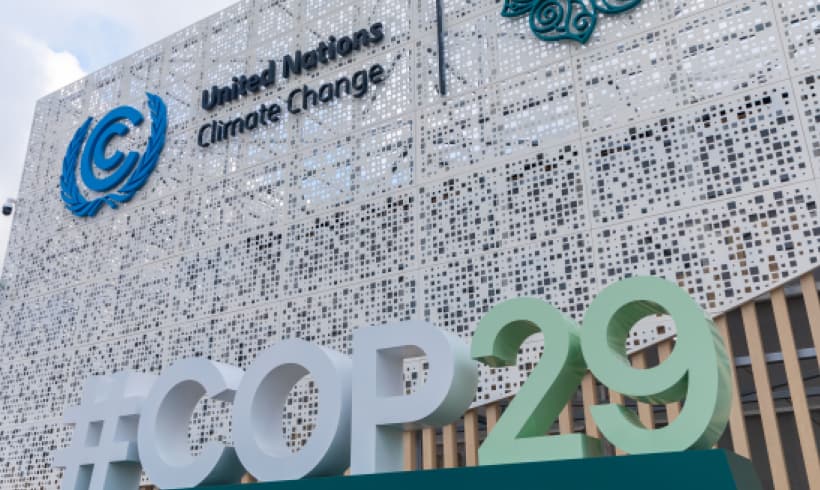
COP 29, the United Nations Climate Change Conference held in Baku, Azerbaijan, has drawn to a close with agreement on certain areas and progress being made on the much-discussed Loss and Damage, as well as the Global Shield, two programs of some relevance to insurance, reinsurance and insurance-linked securities (ILS) markets.

cop29-imageWhile the COP29 meetings concluded with an agreement on financing amounting to $300 billion per-year for developing countries, concern has been raised over that figure falling far-short of the amount those nations believe is required to respond to the climate impacts they are already facing, as well as boost their readiness for and resilience to climate related exposures.

The Fund for Loss and Damage has been designed to help the countries that are most vulnerable to the adverse effects of climate change.

At COP29, agreement has been reached on fully operationalising the loss and damage fund, although there is still significant work to do on the finer details of how support and financing will be delivered.

Working with the Board of the loss and damage fund and the World Bank, the COP29 Presidency said it has advanced measure to operationalise the fund, while also appointing former Group Director General of the parametric risk pooling and parametric insurance facility, African Risk Capacity (ARC), Ibrahima Cheikh Diong as the Fund’s Executive Director.

In addition, key documents were signed at COP29, including a “Trustee Agreement” and “Secretariat Hosting Agreement” between the Fund for Loss and Damage’s Board and the World Bank, as well as a “Host Country Agreement” between the Fund’s Board and the host country, which is set to be the Republic of the Philippines.

Financial support and commitments to the loss and damage fund now exceed $730 million, with the largest contributions made during COP29 coming from Australia and Sweden.

As a result, the COP29 Presidency said that the loss and damage fund is now “ready to distribute funds in 2025 by securing contributor agreements and pledges as well as signing the host country agreement with the Philippines and hosting and trustee agreements with the World Bank.”

As well as the commitments made to the Fund, it is still expected that once operationalised there will be work undertaken to identify whether and how private capital financing instruments also have a role, in financing climate related loss and damage for the most vulnerable and developing nations of the world.

As we’ve also explained in the past, the insurance, reinsurance and insurance-linked securities (ILS) markets have a role to play here, albeit further down the line, once agreement has been reached on financing instruments, tools, structures and how to actually disburse loss and damage fund capacity, are made.

We’ve highlighted the potential for there to be an important role for responsive risk transfer, such as risk transfer and insurance delivered through structures that utilise parametric triggers and risk-sharing systems have been a topic of discussion around loss and damage since the start.

With a former ARC executive now leading the Fund, it will be interesting to see how financing structures can be hybridised, to incorporate elements of risk transfer, to finance responses to future climate disasters, as well as the pure financing for mitigation and resilience that is expected to be needed.

Around the set-up and operationalising of the fund for responding to loss and damage, insurance and related risk transfer instruments have been broadly discussed as having a role to play.

The Fund’s Board has explored examples of risk pooling and parametric insurance, while also gaining an understanding of other risk transfer instruments, including catastrophe bonds.

Premium subsidies are seen as one use-case for financing from the loss and damage fund, although there is a lot of work to do around how any instruments that require premiums to be paid to private market actors are integrated within the overall loss and damage financing deployment.

Which leads us onto the second area of progress seen at COP29 that has relevance for the insurance, reinsurance and ILS community, the setting of a strategic direction for the Global Shield against Climate Risks.

The Global Shield against Climate Risks was launched after COP27, alongside the World Bank officially launching its Global Shield Financing Facility.

These two initiatives embed disaster risk financing techniques, in particular responsive risk transfer and anticipatory financing, at the heart of global efforts to build resilience to climate change and climate driven natural disaster events.

In 2023, the Global Shield Solutions Platform (GSSP) was also launched as a multi-donor grant facility and one of the core financing vehicles of the Global Shield, designed to help vulnerable countries effectively address loss and damage exacerbated by climate change.

Now, at COP29, a strategic direction has been set for the Global Shield initiative, with at least 17 countries targeted for its initial implementation and for specific activities to be taken.

Within the scope is parametric insurance and risk transfer, with use of these instruments expected to be scaled up under the Global Shield, while insurance-linked securities (ILS) such as catastrophe bonds still feature in Global Shield related texts.

At COP29, like previous conferences, the insurance and reinsurance industry was well-represented by key players and the efforts to embed insurance at the heart of climate financing discussions continues.

Efficiency, of risk transfer, and its responsiveness, as well as the efficiency of risk capital itself, will be critical for the future of such efforts.

But so too will investment in mitigation and structural innovation, to identify equitable ways to use the funding appropriately and to harness the appetite of private capital in support of climate financing and the broader climate transition.

Also read: Risk-sharing systems must be a pillar of Loss and Damage architecture: Report.

COP29 ends with Loss and Damage fund progress, strategic direction set for Global Shield was published by: www.Artemis.bm
Our catastrophe bond deal directory
Sign up for our free weekly email newsletter here.

Parametric insurance can help close US $1.8tn protection gap: Generali and UNDP

This content is copyright to www.artemis.bm and should not appear anywhere else, or an infringement has occurred.

A joint report published by insurance giant Generali and the United Nations Development Programme (UNDP) highlights parametric risk transfer and insurance as a key solution that can help to close the US $1.8 trillion protection gap.

UNDP Generali logos“Parametric insurance is speeding up recovery from climate-related hazards and other shock events, especially for communities in vulnerable contexts,” the pair explain.

Adding that case studies show how parametric insurance can contribute to improved financial resilience for households, businesses and global value chains.

Parametric and index-insurance products are seen as viable ways to enable governments, businesses and communities around the world to financially prepare better for what are seen as increasingly frequent and severe natural hazards, ranging from drought, extreme heat and tropical cyclones to storm surges, earthquakes and other shocks.

As parametric policies can provide pre-agreed payouts that are based on independently verified triggers, typically based on the parameters of a weather, climate or catastrophe event instead of assessed losses, it can drive faster payouts and therefore fund a faster recovery from impacts and losses.

Parametrics are seen as a “complementary risk transfer mechanism to fill gaps left by traditional indemnity-based insurance.”

Christian Kanu, CEO of Generali Global Corporate & Commercial (GC&C) commented, “This report demonstrates our commitment to addressing the protection gap by offering innovative insurance solutions that can strengthen the resilience of underinsured communities in many regions of the world. Parametric insurance can be transformative, providing cost-effective, efficient risk coverage to those previously unreachable by traditional insurance. Consequentially, this helps communities and businesses cope with natural hazards and operational interruptions. At Generali GC&C, we are proud to be the Group’s center of excellence for parametric insurance, and we will continue striving to be Lifetime Partners for our clients.”

Jan Kellett, Global and Corporate Lead on Insurance and Risk Finance at UNDP, added, “Of critical importance to this work is the role of government. Our joint UNDP-Generali report makes one thing clear – the insurance industry cannot scale parametric solutions to build financial resilience without the appropriate ecosystem. Development actors must significantly increase efforts to establish supportive regulations and policies that allow parametric insurance to contribute meaningfully to closing the financial protection gap.”

Generali’s partnership with the UNDP has “an ongoing commitment to scale financial protection by fostering wider public-private collaboration,” the pair explain.

The ultimate goal is to help “create the kind of ecosystem necessary to support the growth of parametric insurance as a tool to protect vulnerable communities.”

Previously, the two entities had announced a partnership focused on the creation of digitally enabled parametric insurance solutions.

Parametric insurance can help close US $1.8tn protection gap: Generali and UNDP was published by: www.Artemis.bm
Our catastrophe bond deal directory
Sign up for our free weekly email newsletter here.

Nat cat gap expands 5.2% to $385bn, but protection more available: Swiss Re

This content is copyright to www.artemis.bm and should not appear anywhere else, or an infringement has occurred.

The global natural catastrophe protection gap widened again in 2023, rising 5.2% to US $385 billion in premium equivalent terms, but at the same time Swiss Re reports that there are signs of more protection being available, which over time should see more losses covered by insurance and reinsurance.

swiss-re-instituteSwiss Re’s Institute sigma research team said that the firm’s measure for the global natural catastrophe insurance protection gap widened due to economic growth and inflation last year.

Positively though, “Global protection available increased by 10.1% yoy in 2023, greater than the 6.3% yoy rise in protection needed, resulting in improved resilience, an encouraging underlying trend in risk protection,” the reinsurance company explained.

Adding that, “These growth rates indicate that although there are more, or more expensive, assets to protect, an increasing share of them are covered by insurance.

“This is a positive trend for global resilience if it continues in the long term.”

According to Swiss Re’s analysis, global insurance resilience was stable at 58% in 2023, helped by gains in mortality resilience due to higher life insurance take-up, and in emerging markets’ health resilience as well.

Overall though, the global protection gap across insurance perils reached a new high of US $1.83 trillion in premium equivalent terms in 2023, up by 3.1% in nominal terms from a restated US $1.77 trillion for 2022.

The global protection gap has expanded by 3.6% annually in nominal terms since 2013, Swiss Re said, which roughly matches nominal GDP growth trends.

Natural catastrophe resilience, a measure of how much in economic losses was covered by insurance and reinsurance, rose to 25.7% in 2023.

But Swiss Re noted that a key driver of this was the fact 2023 saw a high proportion of severe convective storm losses, especially in the US, which is a peril and region that is relatively more insured than others.

“The past 10 years have seen improvement in global natural catastrophe insurance resilience. However, the key driver has been a strong rise in advanced markets resilience, which increased to above 38% in 2023 from around 35% in 2013. In emerging markets, resilience is typically still extremely low, and regions are almost entirely unprotected from natural catastrophe risk,” Swiss Re’s sigma team explained.

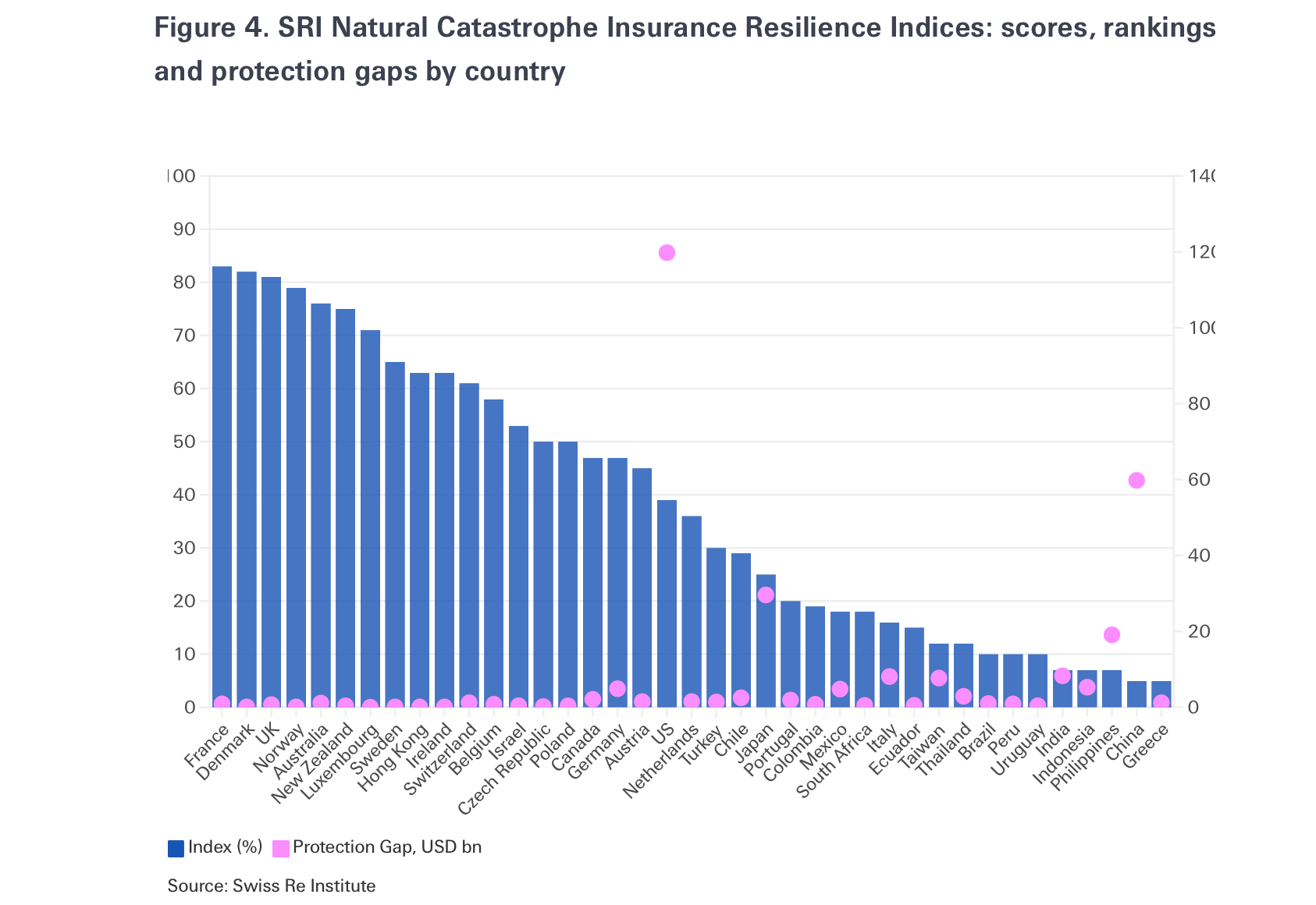
There is a significant dispersion in how resilient and protected by insurance countries are from natural catastrophe events, with some countries such as France, Denmark and the UK indexing above 80% resilient, but the United States down at 39%, and other countries as low as 5%.

natural-catastrophe-resilience-protection-gaps-swiss-re

Demonstrating the continued opportunity to deliver more catastrophe risk capital to support the needs of country’s with high protection gaps, the United States had a significant US $119.8 billion nat cat protection gap in 2023, while China had US $59.8 billion of the global total, Japan US $29.6 billion and the Philippines US $19.1 billion.

Swiss Re noted that global crop resilience is an area of opportunity for the insurance and reinsurance market, with a need to strengthen it further and re/insurance able to play a role.

In addition, the research suggests a growing role for innovative risk transfer arrangements such as those using parametric triggers to help in driving global crop protection higher.

While at the same time, more crop reinsurance coverage is also needed to support expansion of programs and to cover more critical global crop production.

On a more cautionary note, Swiss Re also highlighted that rising natural catastrophe and weather insurance losses are driving prices higher, which can have the effect of widening the protection gap further still.

“So far there has been little evidence that a lack of affordability of property catastrophe insurance is jeopardising resilience gains, but it is yet to be seen if this remains so in the future,” the reinsurer said.

Which speaks to the need for more efficient catastrophe risk capital to help in provision of the reinsurance needed to support primary insurers as they adapt to the nat cat reality we see today.

So, while there may be signs that more protection is available today and that is positive for the future, it appears more capital and capacity, as well as use of innovative risk transfer structures, may be required to meaningfully narrow these gaps.

Nat cat gap expands 5.2% to $385bn, but protection more available: Swiss Re was published by: www.Artemis.bm
Our catastrophe bond deal directory
Sign up for our free weekly email newsletter here.

World Bank & EC call for scaled up European disaster risk transfer & cat bonds

This content is copyright to www.artemis.bm and should not appear anywhere else, or an infringement has occurred.

In a string of research reports, the World Bank Group and European Commission call on governments across Europe to utilise more in the way of disaster risk transfer and insurance to reduce the pressure from weather and natural perils on budgets, including the use of catastrophe bonds to access capital market investors for reinsurance risk capital.

european-commissionThe conclusion of the research is that European countries are retaining far too much of their natural catastrophe risk exposure, with the lions share of the costs continuing to be dealt with by government and European budgets, while too little is transferred to insurance, reinsurance and institutional investor markets.

The World Bank and EC reports state that the continent “needs smart investments to strengthen disaster resilience, adaptation and finance response to disaster and climate risks.”

With Europe seen as warming faster than any other continent, the pair say it is “highly vulnerable to the increasing risks associated with climate change.”

“2023 was the hottest year on record with disasters across Europe costing more than €77 billion. Projected costs of inaction in a high warming scenario could reach 7 percent of EU GDP,” they explain.

“Disasters are devasting for everyone, but can disproportionately impact Europe’s most vulnerable communities, increasing poverty and inequality,” Sameh Wahba, a Director at the World Bank said. “Without adequate systems, these events can erode development gains. There is still time for European countries to take actions that will protect people’s lives, infrastructure, and public finances from disaster and climate change impacts, though there is a narrowing window of opportunity to take action.”

Investment in resilience is a significant focus of the work, with many critical sectors of the European economy seen as exposed to multiple natural hazards.

“Investments in prevention and preparedness are urgently needed at all levels, starting with critical sectors that provide emergency response services,” Hanna Jahns, Director of the European Commission Humanitarian Aid & Civil Protection unit said. “The needs are significant and the pressure on the EU and government budgets is high. Going forward we need to invest in a smart way, prioritizing the investments with the highest resilience “dividends.””

They urge the use of risk and climate change data and analytics, to help in prioritising actions and to select the most impactful prevention, preparedness, and adaptation investments.

In Europe, climate change adaptation costs up to the 2030s are thought likely to be in the range of €15 billion to €64 billion annually, underscoring the significant investment required.

“There is a significant gap in adaptation financing in Europe,” explained Elina Bardram, Director, Directorate-General for Climate Action. “Closing it requires a major scale-up of public, private, and blended finance. Investment planning and financial strategies are not yet adequately informed by an understanding of the costs of climate change adaptation at national and EU levels. This needs to change.”

Where the reports become most relevant for our readers is around financial resilience.

The World Bank and European Commission reports state that, “too much of the disaster and climate risk is managed through budgetary instruments at the EU level and by EU Member States, with gaps concerning pre-arranged funds and the use of risk transfer mechanisms, such as risk insurance. ”

In seeking to maximise societal benefits from investments made, the use of risk transfer alongside this to cushion the costs of climate and natural disasters are seen as key.

Public finances are in some cases being stretched by multiple natural disasters each year, so upfront risk financing and transfer can help to lessen the burden on the budgets of European countries and their populations.

The reports identify funding gaps for major disasters and note that should countries face multiple major events in a year, the impact could drain funding at the EU level (as well as countries specifically).

As a result, the reports state that, “Countries in Europe need to enhance their financial resilience through better data utilization and innovative financial instruments, including risk transfer to the private sector.”

Here, catastrophe bonds are highlighted throughout the reports, as tools that can aid in preparing for financial impacts and enhancing the ability for Europe to fund the response to disasters.

The capital market is seen as one source of risk transfer that Europe should consider.

“At present there are no risk transfer products at the EU level or in the case study countries, and consideration should be given to their incorporation in future DRF strategies,” the report explains.

Citing the use of catastrophe bonds by US utilities for wildfire risk, the reports suggest a potential role in Europe.

“CAT bonds as a risk transfer mechanism are less common in the EU and should be further explored once risk models are available to see if this could provide a cost-effective option to manage the risk of wildfires,” one of the reports says.

Both index and parametric insurance techniques are also suggested as applicable to the disaster funding gaps faced in Europe, as these can help to make for responsive risk transfer tools, that can help in financing recovery quickly after disasters occur.

The European Union Solidarity Fund (EUSF) is seen as a financial structure already in existence that could be supported better by risk transfer.

One of the reports states, “The existing EU level instruments take time to disburse, which may delay emergency response. Due consideration should be given to the introduction of a EU level instrument to provide a top-up to national governments to help them finance emergency response. Such an instrument could be embedded within the European Union Solidarity Fund (EUSF).”

Disaster risk financing and transfer tools and techniques can help European countries and budgets reduce their liabilities after disaster strikes, including through responsive techniques and by tapping the capital markets.

The report continues, “A parametric risk transfer instrument — e.g., a catastrophe bond — could be introduced to secure private capital when needed. This approach would recognize the significant opportunity cost of holding reserves at the EU level and instead structure an additional instrument to release finance into the EUSF when severe events occur.”

The report uses the example set by Mexico, in its use of private insurance, reinsurance and capital markets through its catastrophe bonds, as setting an example that Europe can draw from.

The World Bank sees Mexico as “setting the standard” for disaster risk management through its use of financial instruments such as cat bonds.

The reports go into much more detail around how Europe can put in place safety nets, both for its budgets and for its populations, while making the best use of modern financing techniques, risk transfer tools and the appetites of private and capital markets.

It’s encouraging to see the discussion on Europe continuing, as in the last year we’ve also seen the European Central Bank (ECB) alongside a macro-prudential oversight body it operates, the European Systemic Risk Board (ESRB), calling for greater use of catastrophe bonds to address the insurance protection gap and mitigate catastrophe risks from climate change in the European Union.

World Bank & EC call for scaled up European disaster risk transfer & cat bonds was published by: www.Artemis.bm
Our catastrophe bond deal directory
Sign up for our free weekly email newsletter here.

Munich Re behind Hawaii coral reef parametric insurance renewal, coverage expands

This content is copyright to www.artemis.bm and should not appear anywhere else, or an infringement has occurred.

An innovative parametric insurance product that provides protection to fund repairs following storm damage to coral reefs in Hawaii has been renewed and its coverage expanded, while global reinsurance firm Munich Re is again backing the cover, which is arranged by WTW.

coral-reef-imageBack in November 2022, WTW alongside The Nature Conservancy launched the parametric coral reef insurance concept in the United States for the first time with a policy focused on Hawaii. Munich Re underwrote the risk for that first Hawaiian coral reef parametric insurance arrangement.

The same parametric risk transfer product concept had already been utilised in Mexico and was then expanded to also cover the Mesoamerican Reef system.

As we reported earlier this month, broker WTW has now taken the coral reef insurance concept across the globe to cover a South pacific coral reef in the Fiji archipelago as well.

Now, the Hawaii instance of the product has been renewed, with expanded coverage and higher payouts available, so that it can make more impact on the reef and the communities that rely on it.

The new parametric coral reef insurance policy expands coverage around the main Hawaiian islands and increases payouts after qualifying storms, WTW explained.

The new Hawaiian policy adds 314,976 square miles to the coverage area so that it can capture more storm events, with a maximum payout of $2 million total over the year-long policy period and $1 million possible per storm.

At the same time, the minimum payout after the parametric trigger is activated has doubled to $200,000, enabling a more meaningful post-storm response.

Payouts can be triggered when tropical storm winds of 50 knots or greater occur in the core of the coverage area.

Once again, a Munich Re insurance entity was selected as the coverage provider from seven competitive bids.

WTW said that more companies bid on this year’s policy, which it noted shows “increasing interest among insurers in nature-based solutions to protect against climate impacts.”

“Parametric insurance is increasingly demonstrating value in addressing disaster risk for natural assets, in this case providing Hawai’i with a tangible solution to quickly finance post- storm restoration activities that help reefs better recover and maintain resilience in the face of increasing climate impacts,” explained Simon Young, Senior Director in WTW’s Disaster Risk Finance and Parametrics team. “Increasing recognition of this value by conservation organisations, government bodies and other stakeholders on the demand side and by insurers on the supply side is mainstreaming parametric protections, driving accessibility and sustainability.”

“We are building something really transformative for communities and ecosystems as we respond to increasing storm activity associated with the climate crisis,” added Ulalia Woodside Lee, Executive Director, The Nature Conservancy, Hawai‘i and Palmyra. “The first policy provided momentum to develop response plans and partnerships. With these now in place and an increased minimum payout, we will be able to start damage assessments and reef repairs after a storm as soon as it’s safe to get in the water. This is important because corals must be reattached within several weeks after breaking or they will likely die.”

René Mück, Munich Re’s Global Head of Natural Catastrophe Parametrics, also said ”Using parametric risk transfer as a means to contribute to TNC’s conservation objectives in Hawaii aligns exactly with the objectives of Munich Re’s parametric business unit. We are proud to support TNC in Hawaii and appreciate the work with WTW on such initiatives.”

The parametric coral reef insurance product has already demonstrated its utility, when Hurricane Lisa’s landfall in Belize on November 2nd 2022 triggered the Mesoamerican Reef system parametric insurance product.

Munich Re behind Hawaii coral reef parametric insurance renewal, coverage expands was published by: www.Artemis.bm
Our catastrophe bond deal directory
Sign up for our free weekly email newsletter here.

Parametric insurance to cover South Pacific coral reef in Fiji archipelago

This content is copyright to www.artemis.bm and should not appear anywhere else, or an infringement has occurred.

An innovative parametric insurance program has been taken across the globe to cover a South pacific coral reef in the Fiji archipelago, with broker WTW saying it will provide up to US $450,000 of cover for reef restoration and community assistance if cyclones hit.

coral-reef-parametric-insuranceThe payout would go to Fiji’s island communities, if a cyclone hits the coral reef system of the South Pacific Ocean’s volcano-formed Lau Group of islands.

The Indigenous people of Lau depend on the reef ecosystem as a source of food and income, so protecting it using a parametric risk transfer insurance product that will pay out after a cyclone strikes which could damage the reef, can enable the community to recover faster and put funds into reef conservation, restoration and resilience.

Development insurer and risk pool the Pacific Catastrophe Risk Insurance Company (PCRIC) is the insurer for this South Pacific parametric reef insurance, winning the bid after what WTW called “a competitive placement process.”

WTW worked with local correspondent broker Insurance Holdings (Pacific) Pte Ltd. and Fiji’s Vatuvara Foundation (VVF), which is the policyholder of the parametric insurance programme.

As well as helping to protect and repair the reef in the event of a cyclone, the parametric insurance payouts can be used to support the community with assistance activities to help address food and water security concerns caused by storm damage.

The initial coverage is for Vatuvara Island, a protected natural reserve; Yacata, where the local community resides; and Kaibu, the Vatuvara Private Islands Resort, while further sites in the Lau Seascape may be covered in future years.

Broker WTW has successfully renewed a similar parametric coral reef insurance product for the Mesoamerican coral reef a number of times now, expanding it with each renewal.

Sarah Conway, Director and Ecosystem Resilience Lead, WTW, commented “We are grateful to BHP for supporting the design and implementation of the first coral reef insurance programme in Fiji. Building on lessons learned from our involvement with similar initiatives in other countries, this programme provides an exciting opportunity to innovate beyond rapid reef response to also include community assistance, enhancing the resilience of the ecosystem and those who depend on it.”

PCRIC CEO, Aholotu Palu, stated, “PCRIC is very pleased to demonstrate its commitment to serve non-sovereign entities with innovative parametric insurance products, in line with PCRIC’s mission to help the island communities of the Pacific to better prepare, structure and manage finances to foster disaster resilience and ensure rapid access to funds; the work of the Vatuvara Foundation, both in reef conservation and in local community empowerment, is recognised by the Government of Fiji as being in the national interest and consistent with development priorities, particularly the Blue Pacific Strategy, as well as commitments to climate change adaptation and disaster risk management.”

Katy Miller, Director, Vatuvara Foundation, added, “We are thankful that the innovative parametric policy will allow for the prompt access to funds following a destructive cyclone event to identify reef damage and assist reef recovery with a community-led team in Northern Lau. Increased frequency and severity of extreme weather events is expected in the area, and protecting natural ecosystems in the Lau Group is crucial to build long-term community resilience to anthropogenic threats including climate change.”

Ashley Preston, Head of Climate Resilience, BHP, also said, “BHP is funding an innovative parametric insurance product, which aims to support the conservation of coral reefs and surrounding local communities in Fiji’s northern Lau Group, and build the knowledge base for how similar financial products could be used to improve climate resilience. We are pleased to work with WTW and Vatuvara Foundation on this project, which supports BHP’s commitments to action on climate, conservation and empowering communities.”

Parametric insurance to cover South Pacific coral reef in Fiji archipelago was published by: www.Artemis.bm
Our catastrophe bond deal directory
Sign up for our free weekly email newsletter here.